

Physical gold and silver are the most reliable assets for protecting wealth during financial crises. Known formally as “sound money” or “hard asset wealth preservation,” this strategy centers on owning tangible metals that hold value when paper assets fail. Financial advisors recommend allocating 5–15% of a total portfolio to physical precious metals for crisis insurance, commonly split 70% gold and 30% silver. That split reflects a deliberate choice: gold for stability, silver for tactical upside. Building crisis-proof wealth with physical gold and silver starts with understanding why physical ownership matters above all else.
How are gold and silver different in protecting wealth during market crises?
Gold and silver both protect wealth, but they do it in different ways. Treating them as identical assets is a mistake that costs investors real money.
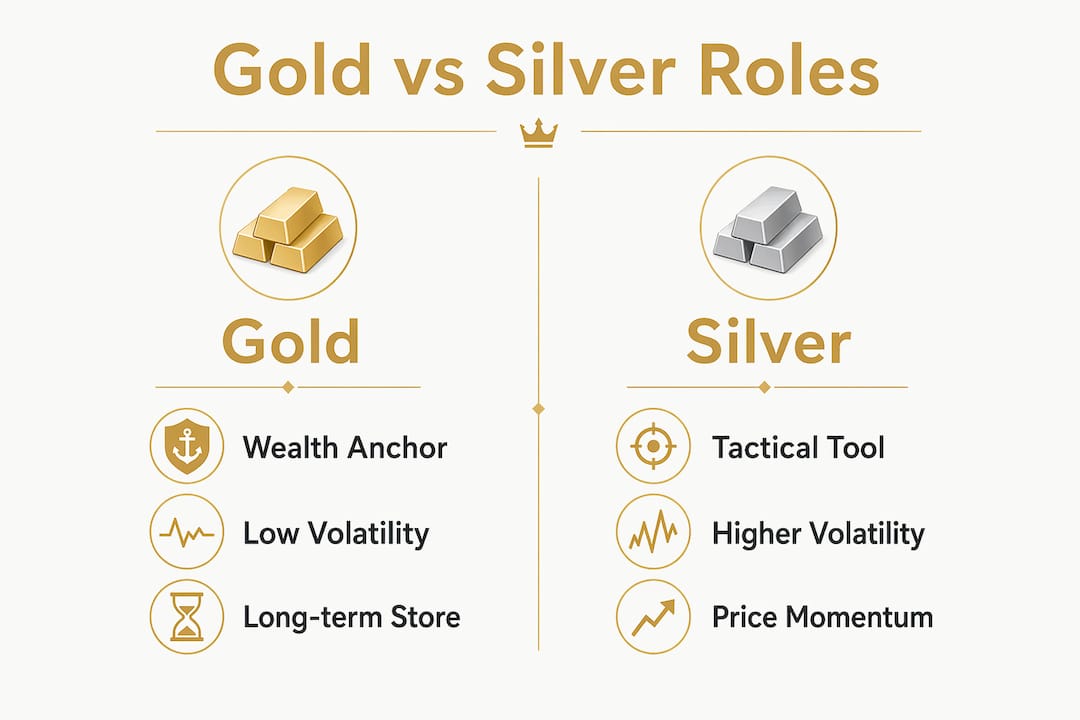
Gold as the stability anchor
Gold is a global store of value with thousands of years of monetary history behind it. Central banks hold gold as a reserve asset precisely because it holds purchasing power across currency collapses, hyperinflation, and banking failures. Gold acts as a global anchor for wealth preservation against systemic risk, according to market analyst Lynette Zang. That means when the financial system seizes up, gold does not depend on any institution to maintain its value.

Silver as a tactical tool
Silver behaves differently. Its price moves more sharply in both directions, making it more volatile than gold. Silver also has significant industrial demand, from solar panels to electronics, which ties its price to economic cycles. That industrial link is actually useful: silver often signals market shifts before they show up in other asset classes. Silver’s volatility and industrial use make it a tactical asset, not a pure safe haven. Investors who understand this use silver to capture upside during recoveries while relying on gold for core protection.
Comparing their crisis roles
| Attribute | Gold | Silver |
|---|---|---|
| Primary role | Wealth preservation anchor | Tactical, higher-volatility asset |
| Volatility | Lower | Higher |
| Industrial demand | Minimal | Significant |
| Liquidity | Very high | High |
| Crisis behavior | Stable store of value | Amplified moves, signals market shifts |
The gold-to-silver ratio, which measures how many ounces of silver equal one ounce of gold, is a widely used tool for timing allocation shifts. When the ratio is historically high, silver is relatively cheap and may offer better tactical value. When it narrows, gold’s relative strength reasserts itself.
Pro Tip: Track the gold-to-silver ratio over time. A ratio above 80 has historically favored adding silver to a portfolio; a ratio below 50 has favored trimming it back toward gold.
What are the key prerequisites before investing in physical gold and silver?
Getting the allocation right before you buy a single coin or bar is the most important step most investors skip.
Allocation and portfolio balance
Financial advisors recommend a 5–15% allocation to physical precious metals for crisis insurance. Some wealth preservation frameworks push that range to 30% for investors with higher exposure to systemic risk. The 70/30 gold-to-silver split within that allocation is the most widely cited starting point. These are not rigid rules, but they reflect decades of portfolio stress-testing across recessions, currency crises, and banking panics.
Physical ownership versus paper proxies
Physical ownership eliminates counterparty risk that ETFs and paper proxies cannot. A gold ETF is a financial contract. During a systemic freeze, ETFs and paper proxies may deny physical redemption entirely, which makes them useless for true crisis protection. Physical metal in your possession or in an allocated vault carries no such dependency. That distinction is the entire foundation of a sound crisis-protection strategy.
Tax-advantaged options: the self-directed Gold IRA
Investors who want to hold physical metals inside a retirement account can use a self-directed Gold IRA. Physical gold within a Gold IRA must be held in IRS-approved depositories and involves setup, custodial, and storage fees that affect net returns. That fee structure is real and must be factored into any return calculation. Goldrockmetalexchange operates a dedicated in-house IRA department that simplifies the transfer of existing retirement accounts into physical precious metals IRAs, which removes much of the paperwork burden.
Costs and realistic expectations
Precious metals do not bear interest or dividends and involve storage, insurance, and dealer premium costs. That is not a flaw. It is the nature of a crisis-protection asset. Investors who expect gold and silver to outperform equities every year misunderstand the purpose. The goal is wealth preservation across crises, not maximum annual return.
Pro Tip: Before buying, request a full fee disclosure from any dealer. Dealer premiums, storage fees, and bid-ask spreads all reduce net returns. Knowing the total cost of ownership upfront prevents surprises.
How to acquire and securely store physical gold and silver
Buying physical metals correctly requires more than finding a low price. Authenticity, product choice, and storage all determine whether your investment actually protects you.
Step 1: Choose a reputable dealer
Work only with dealers who disclose premiums clearly, have verifiable business histories, and offer insured delivery. Goldrockmetalexchange provides transparent pricing and insured private delivery on all physical purchases. Avoid dealers who pressure you into quick decisions or obscure their fee structures.
Step 2: Select the right product type
- Gold coins (such as American Gold Eagles or Canadian Maple Leafs) offer high liquidity and easy resale in small increments.
- Gold bars carry lower premiums per ounce but are less liquid in smaller transactions.
- Silver coins and rounds are accessible entry points with strong recognizability.
- Silver bars offer cost efficiency for larger purchases.
Physical gold bars typically offer lower premiums than coins, but coins provide higher liquidity and ease of resale in smaller increments. For crisis protection, liquidity matters. A mix of both formats serves most investors well.
Step 3: Verify authenticity
Purchase only from dealers who source IRS-approved or internationally recognized bullion. Use a calibrated scale and a Sigma Metalytics verifier or similar device if you are buying secondhand. Counterfeit bars exist, and visual inspection alone is not sufficient.
Step 4: Choose your storage method
Storage options for physical precious metals include home safes and professional vaulted storage. Each has real tradeoffs:
- Home storage keeps metals fully accessible but increases theft and fire risk. A quality fireproof safe bolted to the structure is the minimum standard.
- Professional vaulted storage reduces theft risk and typically includes insurance, but adds ongoing fees and creates some distance from your assets.
- Segregated, allocated vault storage means your specific metals are held separately under your name, not pooled with other clients’ holdings. This is the highest standard for third-party storage.
For Gold IRA holdings, IRS rules require storage in an approved depository. Personal possession of IRA metals is not permitted and triggers tax penalties.
What common mistakes should investors avoid with precious metals?
Most wealth preservation strategies fail not because the metals underperform, but because investors make avoidable structural errors.
- Relying on ETFs for crisis protection. During systemic freezes, paper proxies may deny physical redemption. Only physical metals in your possession or an allocated vault provide true protection.
- Ignoring total cost of ownership. Storage fees, insurance, custodial costs, and dealer premiums all reduce net returns. Calculate these before committing capital.
- Overconcentrating in precious metals. Allocating more than 30% of a portfolio to metals removes the diversification that makes a wealth preservation strategy durable. Diversification beyond precious metals, incorporating equities, alternatives, and physical commodities, is necessary to preserve purchasing power across full market cycles.
- Treating gold and silver as identical. Gold is your stability anchor. Silver is your tactical tool. Confusing the two leads to poor allocation decisions.
- Expecting short-term gains. Physical metals are a long-term wealth preservation strategy, not a trading vehicle. Investors who buy expecting rapid price appreciation often sell at the wrong time.
Pro Tip: Review your metals allocation annually. Rebalance if precious metals have grown beyond your target range due to price appreciation, just as you would rebalance any other asset class.
Key takeaways
Physical gold and silver protect wealth most effectively when held in physical form, allocated correctly within a portfolio, and stored with full elimination of counterparty risk.
| Point | Details |
|---|---|
| Allocate 5–15% to precious metals | Split 70% gold and 30% silver for balance between stability and tactical exposure. |
| Physical ownership is non-negotiable | ETFs and paper proxies carry counterparty risk that fails during systemic financial crises. |
| Gold anchors, silver signals | Use gold for core preservation and silver as a tactical asset tied to market cycles. |
| Know your total costs | Dealer premiums, storage fees, and custodial charges all reduce net returns and must be calculated upfront. |
| Diversify beyond metals | Precious metals work best as one layer of a broader wealth preservation strategy, not as the entire portfolio. |
Why I think most investors get precious metals completely wrong
Most people buy gold or silver because they are scared. That is understandable. But fear-driven buying leads to the exact mistakes that undermine the strategy: buying at price peaks, overconcentrating, and choosing paper proxies because they are easier to purchase through a brokerage account.
The investors I have seen build genuinely durable wealth with precious metals share one trait: they treat gold as insurance, not speculation. They are not trying to time the market. They are removing a specific category of risk from their financial lives. That risk is counterparty dependency. Every paper asset you own depends on an institution to honor its obligations. Physical gold in an allocated vault or in your possession depends on nothing and no one.
Silver is where the discipline gets harder. Its price swings are dramatic, and it is tempting to trade it like a commodity. The investors who use silver well treat it as a tactical complement to gold, not as a replacement. They watch the gold-to-silver ratio, they size their silver position smaller than their gold position, and they do not panic when silver drops 20% in a correction.
The other thing most articles will not tell you: the process of buying and storing physical metals is genuinely straightforward when you work with the right dealer. The complexity is mostly perceived. Goldrockmetalexchange’s precious metals education resources cut through that complexity with clear, practical guidance. The hard part is not the mechanics. The hard part is committing to a long-term strategy when short-term noise is loud.
— Blake
Goldrockmetalexchange: your partner for physical precious metals
Protecting your wealth with physical gold and silver requires a dealer you can trust to deliver the right products at fair prices, with the storage and retirement account options to match your specific situation.

Goldrockmetalexchange is a full-service precious metals dealer specializing in wealth protection through physical gold, silver, platinum, and palladium. The company’s in-house IRA department handles the transfer of existing retirement accounts into self-directed precious metals IRAs with IRS-approved storage. For direct purchases, Goldrockmetalexchange offers a full range of coins and bars with transparent pricing and insured private delivery. Whether you are building a new position or expanding an existing one, the team provides personalized guidance at every step.
FAQ
What is the recommended allocation for physical gold and silver?
Financial advisors recommend allocating 5–15% of a total portfolio to physical precious metals. A common starting split is 70% gold and 30% silver for balance between stability and tactical exposure.
Why is physical ownership better than a gold ETF for crisis protection?
Physical metals eliminate counterparty risk. During systemic financial crises, ETFs and paper proxies may deny physical redemption, making them unreliable for true wealth protection.
Can I hold physical gold in a retirement account?
Yes. A self-directed Gold IRA allows you to hold IRS-approved physical gold in an approved depository. Setup, custodial, and storage fees apply and affect net returns.
What is the safest way to store physical gold and silver?
Segregated, allocated vault storage at a professional depository is the highest standard. Home storage in a quality fireproof safe is an option for smaller holdings, but increases theft and fire risk.
Is silver a safe haven like gold?
Silver is more volatile than gold and has significant industrial demand, which makes it a tactical asset rather than a pure safe haven. It complements gold in a portfolio but should not replace it as the primary crisis-protection holding.