

A Gold IRA is a self-directed IRA that holds IRS-approved physical precious metals under IRC §408(m), and three rules govern virtually every compliance question you will face: the metals must meet minimum fineness thresholds (gold at .995, with a statutory exception for the American Gold Eagle), they must be held by an IRS-approved custodian or trustee, and they must be stored in an approved depository — never in your home or personal possession. The four eligible metal categories are gold, silver, platinum, and palladium, each with its own fineness floor. IRS Publication 590-B governs distribution rules and required minimum distributions (RMDs). GoldRock Metal Exchange’s in-house IRA department coordinates custodian-aligned rollovers and ships IRA-eligible metals directly to approved depositories, supporting every documentation step along the way.
- Eligible metals: gold meeting a minimum fineness threshold, silver, platinum, and palladium each meeting their respective minimum fineness thresholds
- American Gold Eagle exception: statutory carve-out under IRC §408(m)(3) permits Eagles despite their lower fineness
- Custodial requirement: metals must be in the physical possession of an IRS-approved bank or nonbank trustee
- Storage: IRS-approved depository only — home storage is a prohibited arrangement
- Tax basics: Traditional = ordinary income on withdrawal; Roth = potentially tax-free; early withdrawal = 10% penalty
- RMDs: required beginning at age 73 under SECURE 2.0 for Traditional accounts
- Prohibited transactions: self-dealing, personal use, and home storage risk full account disqualification under IRC §4975
Key Takeaways
A Gold IRA is a self-directed IRA governed by IRC §408(m) that requires IRS-approved metals, a qualified custodian, and approved depository storage — home storage is prohibited and triggers full account taxation.
| Point | Details |
|---|---|
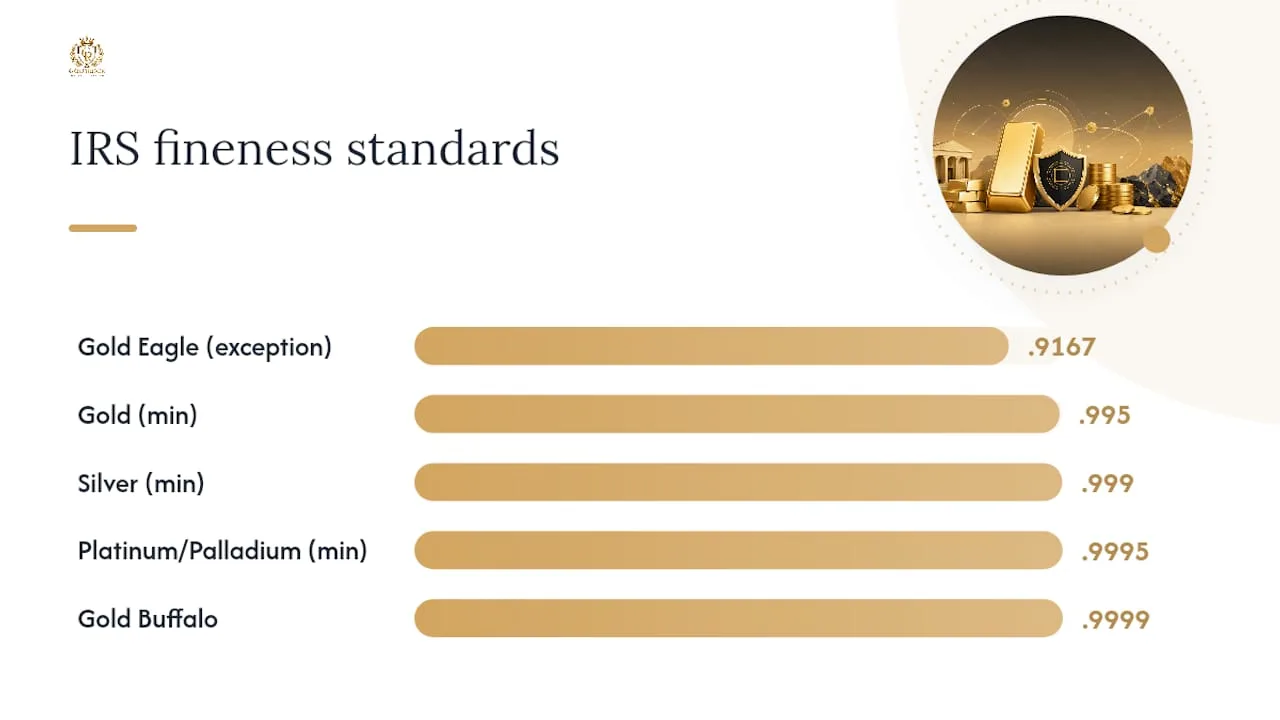
| Fineness requirements | Gold must be .995 minimum; American Gold Eagles are the statutory exception at .9167 fineness. |
| Custodial storage is mandatory | IRA metals must be held by an IRS-approved custodian in an approved depository — never in personal possession. |
| Tax treatment by account type | Traditional distributions are taxed as ordinary income; Roth qualified withdrawals can be tax-free when IRS requirements are met. |
| Early withdrawal penalty | Withdrawals before age 59½ generally trigger a 10% penalty plus applicable income tax on the distribution amount. |
| GoldRock Metal Exchange | GoldRock’s in-house IRA department coordinates compliant rollovers, verifies metal eligibility, and ships directly to approved depositories. |
Table of Contents
- What a Gold IRA actually is — and how it differs from a standard IRA
- Which coins, bars, and rounds meet IRS fineness requirements
- Why home storage is prohibited and what custodial rules actually require
- How to open, fund, and add precious metals to your IRA
- Tax treatment, distributions, and RMDs for Gold IRAs
- Prohibited transactions, disqualified persons, and mistakes that disqualify an IRA
- What Gold IRAs actually cost — fees and expenses broken down
- How to choose a custodian and depository — the questions that matter
- How GoldRock Metal Exchange supports compliant IRA rollovers
- A balanced view on when a Gold IRA actually makes sense
- GoldRock Metal Exchange: your partner for a compliant Gold IRA
- Sources
What a Gold IRA actually is — and how it differs from a standard IRA
“Gold IRA” is industry shorthand, not an official IRS term. The legal structure is a self-directed IRA — an individual retirement account that grants the account holder authority to direct investments into assets beyond the stocks, bonds, and mutual funds that standard brokerage IRAs offer. Physical precious metals are one such asset class, permitted under the narrow exceptions carved out by IRC §408(m)(3).
The operational difference from a standard IRA is significant. Most major brokerages do not offer self-directed IRAs because the custody model is different: a specialty custodian (a bank, credit union, or IRS-approved nonbank trustee) must hold the account and take physical possession of the metals through an approved depository. Your brokerage cannot simply add a gold bar to your existing Fidelity or Vanguard account.
Tax wrapper options work the same way as any IRA:
- Traditional Gold IRA: contributions may be tax-deductible; distributions in retirement are taxed as ordinary income
- Roth Gold IRA: contributions are after-tax; qualified withdrawals in retirement can be tax-free when IRS requirements are met
- SEP Gold IRA: available to self-employed individuals and small business owners, with higher contribution limits
The Roth vs. Traditional choice carries real long-term weight for gold specifically. If gold appreciates substantially before you withdraw, a Roth structure means those gains come out tax-free — whereas a Traditional account taxes every dollar of appreciation as ordinary income at your future rate. Tax professionals consistently flag this as one of the most consequential decisions in Gold IRA planning.
“A Gold IRA is not a separate IRS account type — it is a self-directed IRA that can hold multiple IRS-approved metals, requires a specialty custodian, and does not allow rolling in personally held metals as an in-kind contribution.”
Investopedia
Pro Tip: When evaluating any custodian, ask three specific questions before signing anything: What is the name of your IRS-approved depository? Are you a bank custodian or an IRS-approved nonbank trustee? Can you provide written confirmation of your custody arrangement? Vague answers to any of these are a red flag.
Which coins, bars, and rounds meet IRS fineness requirements
The IRS does not approve every gold product on the market. IRC §408(m)(3) sets the legal framework: gold must meet a minimum fineness of .995 (99.5% pure), silver .999, and platinum and palladium .9995. The one statutory exception is the American Gold Eagle, which carries a .9167 fineness but is explicitly permitted by name in the statute.
The IRS guidance on collectibles makes the broader principle clear: most collectibles are disallowed in IRAs, but government-minted coins and bullion that meet defined fineness standards and custody rules fall outside that prohibition.
IRS-approved coins and bullion — a working checklist:
- American Gold Eagle (1 oz, 1/2 oz, 1/4 oz, 1/10 oz) — statutory exception, .9167 fineness
- American Gold Buffalo (1 oz) — .9999 fineness, meets .995 threshold
- American Silver Eagle (1 oz) — .999 fineness
- American Platinum Eagle (1 oz) — .9995 fineness
- American Palladium Eagle (1 oz) — .9995 fineness
- Canadian Gold Maple Leaf (.9999 fineness)
- Canadian Silver Maple Leaf (.9999 fineness)
- Austrian Gold Philharmonic (.9999 fineness)
- Australian Gold Kangaroo/Nugget (.9999 fineness)
- Gold bars and rounds from COMEX/NYMEX-approved or recognized refiners, .995 minimum
What does NOT qualify:
- Numismatic and collectible coins (pre-1933 U.S. gold coins, rare coins valued above melt)
- South African Krugerrands (.9167 fineness, no statutory exception)
- Most private-mint rounds that lack accredited refiner documentation
- Proof coins in some custodian interpretations, unless they meet fineness and are in original mint packaging
“The IRS carves out narrow exceptions for certain government-minted coins and bullion that meet defined fineness standards and custody rules — most collectibles remain disallowed.”
IRS — Investments in collectibles
Pro Tip: Before purchasing, request the refiner’s hallmark documentation and confirm the refiner appears on the COMEX/NYMEX approved list or carries national mint credentials. Your custodian should require this documentation before accepting delivery — if they do not ask for it, that is worth questioning.
Why home storage is prohibited and what custodial rules actually require
IRA-held metals must be in the physical possession of an IRS-approved custodian or trustee and stored in an approved depository. That is the rule, with no meaningful exceptions. IRS retirement plan FAQs and IRS Announcement 2023-10 both stress this custody requirement and document enforcement actions against home-storage arrangements.

The “home storage Gold IRA” concept circulates online, often promoted through checkbook-LLC structures where an IRA-owned LLC holds the metals and the account owner serves as LLC manager. Tax courts have consistently rejected this structure. The McNulty v. Commissioner decision is the most cited precedent: the court held that IRA-owned metals in the account owner’s personal possession constitute a deemed distribution, triggering full account taxation in the year of the event.
Legal custody models compared:
| Custody model | IRS status | Practical notes |
|---|---|---|
| Bank custodian with approved depository | Fully compliant | Most common structure; bank holds title, depository holds physical metal |
| IRS-approved nonbank trustee with approved depository | Fully compliant | Specialty firms approved by IRS; same depository requirement applies |
| IRA-owned LLC with account owner as manager | Disallowed | Treated as personal possession; deemed distribution risk |
| Home storage (any structure) | Disallowed | No IRS-approved arrangement permits this; immediate distribution risk |
Segregated vs. commingled storage is a separate decision within compliant depositories. Segregated storage keeps your specific bars or coins physically separate and identifiable; commingled storage holds your metal alongside other clients’ holdings of the same type. Both are IRS-compliant when the depository is approved. Segregated storage typically costs more but provides clear identification of your specific assets. You can learn more about storage options for IRA metals and how each model affects insurance and audit reporting.
Caution: If a custodian or dealer suggests any arrangement that results in you physically receiving or controlling IRA metals before distribution, treat that as a disqualifying event. The tax consequence is not a penalty — it is full account taxation.
How to open, fund, and add precious metals to your IRA
The safest funding path is a direct trustee-to-trustee transfer or a direct rollover from an employer plan. Both move funds without the money passing through your hands, which eliminates the risk of a taxable event. The IRS rollover rules also impose a once-per-12-month limitation on indirect (60-day) rollovers between IRAs — a constraint that does not apply to direct transfers.
You cannot roll personally owned gold into an IRA in-kind. The IRS requires retirement funds to purchase IRA-eligible metals, and the dealer must ship directly to the approved depository. Bringing your own gold bars to a custodian and calling it a contribution is not permitted.
Step-by-step process:
- Choose a qualified custodian. Confirm the custodian is a bank, credit union, or IRS-approved nonbank trustee. Get the depository name in writing.
- Open the self-directed IRA account. Complete the custodian’s application and designate the account type (Traditional, Roth, or SEP).
- Initiate the transfer or rollover. For existing IRAs, use a direct trustee-to-trustee transfer. For 401(k) or employer plans, request a direct rollover to avoid the 20% mandatory withholding on indirect distributions.
- Select IRA-eligible metals. Confirm each product meets fineness requirements and appears on your custodian’s approved metals list.
- Place the purchase order through your dealer. The dealer invoices the custodian, not you personally. Funds move from the custodian to the dealer.
- Dealer ships directly to the approved depository. You never take possession. The depository issues a receipt.
- Confirm receipt and account reporting. Your custodian updates the account statement. Retain the dealer invoice, depository receipt, and custodian confirmation for your tax records.
Documentation to collect and keep:
- Completed transfer or rollover authorization forms
- Dealer invoice showing product description, weight, fineness, and refiner hallmarks
- Depository receipt with receipt number and storage designation (segregated or commingled)
- Custodian account statement reflecting the new holdings
- Any assay certificates provided by the refiner or dealer
Pro Tip: Request everything in writing before funds move. A verbal confirmation from a dealer or custodian representative is not documentation — the invoice, depository receipt, and custodian statement are what protect you in a compliance review.
Annual IRA contribution limits apply to Gold IRAs the same as any IRA. Rollovers and transfers from existing retirement accounts are not subject to these annual limits.
Ready to start? GoldRock Metal Exchange’s in-house IRA team walks through every step of this process with you. Request a Free Precious Metals Consultation at Goldrockmetalexchange or call (888) 859-0978.
Tax treatment, distributions, and RMDs for Gold IRAs
Traditional Gold IRA withdrawals are taxed as ordinary income at your rate in the year of distribution. Roth qualified withdrawals can be tax-free when IRS requirements are met — the account must be at least five years old and the owner at least 59½. Early withdrawals before 59½ from either account type generally trigger a 10% penalty on top of any applicable income tax, as CBS News summarizes in its review of common Gold IRA tax mistakes.
Traditional vs. Roth Gold IRA — distribution comparison:
| Feature | Traditional Gold IRA | Roth Gold IRA |
|---|---|---|
| Contributions | Pre-tax (may be deductible) | After-tax (not deductible) |
| Withdrawals in retirement | Taxed as ordinary income | Tax-free if qualified |
| Early withdrawal penalty (before 59½) | 10% plus income tax | 10% on earnings (contributions can be withdrawn penalty-free) |
| RMDs required | Yes, beginning at age 73 | No RMDs during owner’s lifetime |
IRS Publication 590-B governs the full distribution rules, RMD timing, and tax treatment for both account types. Under the SECURE 2.0 Act, the RMD starting age increased to 73 for individuals who turn 72 after December 31, 2022.
Satisfying RMDs with physical metals presents a practical challenge. You have two options: sell enough metal to generate the required cash distribution, or take an in-kind distribution of physical metal equal to the RMD value. In-kind distributions require a fair market valuation of the metal on the distribution date, and the custodian reports the distribution to the IRS on Form 1099-R. The metal then leaves the IRA and becomes personally owned — at which point it is no longer subject to IRA rules.
One scenario that catches investors off guard: if IRA-owned metals are transferred to your personal possession for any reason other than a formal distribution, the IRS treats the entire account as distributed in that tax year. This is not a theoretical risk — it is the mechanism behind the home-storage enforcement actions.
Prohibited transactions, disqualified persons, and mistakes that disqualify an IRA
Transactions with disqualified persons or personal possession of IRA metals trigger full-account distribution under IRC §4975. A disqualified person includes you, your spouse, your lineal descendants and their spouses, IRA fiduciaries, and any entity in which a disqualified person holds a significant interest.
Common prohibited transactions to avoid:
- Buying metals from yourself or a family member and placing them in the IRA
- Selling IRA-held metals to yourself or a disqualified person
- Pledging IRA metals as collateral for a personal loan
- Using IRA-held metals for personal display, even temporarily
- Any home-storage arrangement, regardless of the legal structure used
- Receiving compensation for managing IRA assets (self-dealing as a fiduciary)
- Purchasing metals from a dealer in which you hold a controlling interest
Red-flag checklist before any transfer or dealer arrangement:
- Does the dealer or custodian suggest you can store metals at home?
- Is the custodian unable to name a specific IRS-approved depository?
- Does the arrangement involve an LLC you manage holding the physical metals?
- Is the dealer also serving as the custodian?
- Are refiner hallmarks absent from the invoice?
- Does the buyback policy require you to take physical possession first?
Any “yes” answer warrants a pause and independent legal review before proceeding.
Pro Tip: Structure every dealer purchase as an arms-length transaction: the custodian issues payment directly to the dealer, the dealer ships directly to the depository, and you receive only the documentation. Never handle the metals or the funds yourself at any point in the chain.
What Gold IRAs actually cost — fees and expenses broken down
Gold IRAs cost more to operate than standard brokerage IRAs. The additional expense comes from four sources: dealer premiums at purchase, custodian fees, depository storage and insurance fees, and one-time setup costs.
Hidden or negotiable fees to ask about before signing:
- Minimum account balance requirements and fees for falling below them
- Outbound wire or transfer fees when moving funds
- Shipping and insurance costs for delivery to the depository
- Assay or verification fees charged on receipt
- Buyback spread — the difference between the price you paid and what the dealer will pay to repurchase
- Termination or account-closing fees
Pro Tip: *Request a complete fee schedule in writing before opening the account. Compare the all-in annual cost (custodian fee plus storage plus insurance) against the value of your holdings to understand the drag on returns.
How to choose a custodian and depository — the questions that matter
The right custodian and depository combination demonstrates clear custody control, transparent fees, insured storage, and consistent IRS reporting. Choosing based on marketing materials alone is insufficient — the questions you ask before opening the account are what separate compliant arrangements from problematic ones.
Must-ask questions for any custodian:
- Are you a bank, credit union, or IRS-approved nonbank trustee? (Request written confirmation.)
- Which specific depository do you use, and is it IRS-approved?
- Do you offer segregated storage, and what is the cost difference?
- Who insures the inventory, and what is the coverage limit?
- How are my holdings reported to the IRS, and on which forms?
- What is your process for taking in-kind distributions?
- What documentation do you require from the dealer at purchase?
- What are your buyback policies and procedures?
Red flags that warrant walking away:
- Any suggestion that home storage or a checkbook LLC is a compliant option
- Inability to name the specific depository or provide its contact information
- Vague or missing refiner accreditation requirements for purchased metals
- No written fee schedule or fees that change after account opening
- Pressure to decide quickly or claims that IRS rules are flexible
Verifying refiner accreditation means checking that the gold bars or coins you purchase come from a refiner on the COMEX/NYMEX approved list or carry credentials from a recognized national mint such as the U.S. Mint. Request the hallmark documentation and assay certificate from your dealer before the purchase order is placed. Your custodian should independently verify these credentials before accepting the metals into the depository.
For a detailed guide to storing physical gold safely for retirement, including depository verification steps and what to look for in audit reports, GoldRock’s education resources cover the operational specifics.
Pro Tip: Ask the depository directly — not just the custodian — whether your account will be segregated or commingled, and request a sample depository receipt before committing. A depository that cannot produce a sample receipt or explain its audit process is not one you want holding your retirement assets.
How GoldRock Metal Exchange supports compliant IRA rollovers
GoldRock Metal Exchange provides a documented, custodian-aligned rollover process that ships dealer-purchased, IRA-eligible metals directly to approved depositories and supports every required documentation step. The in-house IRA department coordinates trustee-to-trustee transfers, verifies metal eligibility and hallmarks before purchase, instructs insured delivery to the IRS-approved depository, and supplies the dealer invoices, depository receipts, and custodian confirmations you need for your tax records.
GoldRock’s IRA process in practice:
- Initial consultation to review your existing retirement accounts and rollover options
- Custodian coordination — GoldRock works with your chosen custodian to confirm account setup and transfer authorization
- Metal selection from IRA-eligible inventory, with fineness and hallmark verification before order placement
- Custodian-to-dealer payment — funds move directly from your custodian to GoldRock; you never handle them
- Insured delivery from GoldRock directly to your IRS-approved depository
- Documentation package: dealer invoice with refiner hallmarks, depository receipt, and custodian confirmation provided to you for your records
Pro Tip: Request the custodian and depository names in writing at the start of the process, and confirm that your dealer invoice shows the refiner name, hallmark, weight, and fineness for every product purchased. These details are what a compliance review will look for.
Educational disclaimer: The information in this guide is for general educational purposes only. It does not constitute tax, legal, or investment advice. Gold IRA rules are complex and your specific situation may differ. Consult a qualified tax advisor or attorney before making decisions about your retirement accounts.
GoldRock’s IRA services page outlines the full rollover process, eligible metals inventory, and how to get started. You can also reach the IRA team directly at (888) 859-0978.
A balanced view on when a Gold IRA actually makes sense
A Gold IRA is appropriate when your objective is physical metal ownership inside a tax-advantaged wrapper and you accept the higher operating costs and storage constraints that come with it. That is a narrower use case than the marketing around Gold IRAs often suggests.
The trade-offs are real. Physical metal ownership within an IRA adds diversification and a tangible asset that behaves differently from equities and bonds. But the annual cost structure — custodian fees, storage, insurance, and dealer premiums at purchase — creates a drag that a standard brokerage IRA holding paper assets does not carry. For smaller account balances, that cost drag can be significant relative to the holdings.
Liquidity is the other constraint most investors underestimate. Selling IRA-held metals requires instructing the custodian, finding a buyer or using the dealer’s buyback program, and waiting for settlement. It is not the same as selling a stock in a brokerage account. RMD obligations add another layer: if you reach age 73 with a large portion of your IRA in physical metal, satisfying the RMD may require selling metal at whatever the current price is, regardless of market conditions.
None of this makes a Gold IRA a poor choice — it makes it a specific choice that fits specific objectives. Investors who want physical metal exposure within a retirement account, understand the compliance requirements, and have verified their custodian and depository credentials are in a reasonable position to proceed. Verify those credentials before transferring any funds. The compliance structure is not optional, and the consequences of getting it wrong are measured in full account taxation, not just penalties.
GoldRock Metal Exchange: your partner for a compliant Gold IRA
Physical metal ownership in a retirement account requires more than a purchase decision — it requires a verified custodian, an IRS-approved depository, documented transfers, and a dealer who ships directly to storage without putting metals in your hands. That is exactly the process GoldRock Metal Exchange is built around.

GoldRock’s in-house IRA department handles the coordination that makes compliant rollovers straightforward: verifying metal eligibility, managing custodian-to-dealer payment, arranging insured delivery to approved depositories, and providing the complete documentation package your tax records require. The IRA-eligible inventory covers gold, silver, platinum, and palladium products that meet IRS fineness standards, with hallmark verification at every step.
Request a Free Precious Metals Consultation at Goldrockmetalexchange or call (888) 859-0978 to speak with a GoldRock IRA specialist about your rollover options.
Sources
The rules covered in this guide draw from a small set of primary authorities. Each one is publicly available and worth bookmarking if you are actively setting up or reviewing a Gold IRA.
- U.S. Code §408 — Individual retirement accounts
- Understanding Gold IRAs: Benefits, Setup, and Risks Explained
- Gold IRA rules and taxes: Withdrawals, penalties and common mistakes to avoid – CBS News
“The IRS carves out narrow exceptions for certain government-minted coins and bullion that meet defined fineness standards and custody rules — most collectibles remain disallowed in IRAs.”
IRS — Investments in collectibles in individually directed qualified plan accounts
This article is for general educational purposes only and does not constitute tax, legal, or investment advice. Consult a qualified tax advisor or attorney to evaluate how Gold IRA rules apply to your specific situation.
This article is general information, not a substitute for advice from a qualified financial advisor. Consult a qualified financial professional about your own circumstances before acting on anything here.