

Precious metals delivery is the physical transfer of gold, silver, platinum, or palladium from a dealer to a buyer, with security and insurance built into every step. Understanding your precious metals delivery options explained clearly is the difference between a protected acquisition and a costly mistake. Carriers like UPS, FedEx, and USPS handle the majority of retail shipments, while specialized logistics firms manage high-value institutional transfers. Goldrockmetalexchange provides fully insured, tracked delivery with discreet packaging for every order, giving buyers a clear standard to measure any dealer against. Knowing what to expect before your shipment leaves the warehouse puts you in control.
What are the main delivery methods for precious metals?
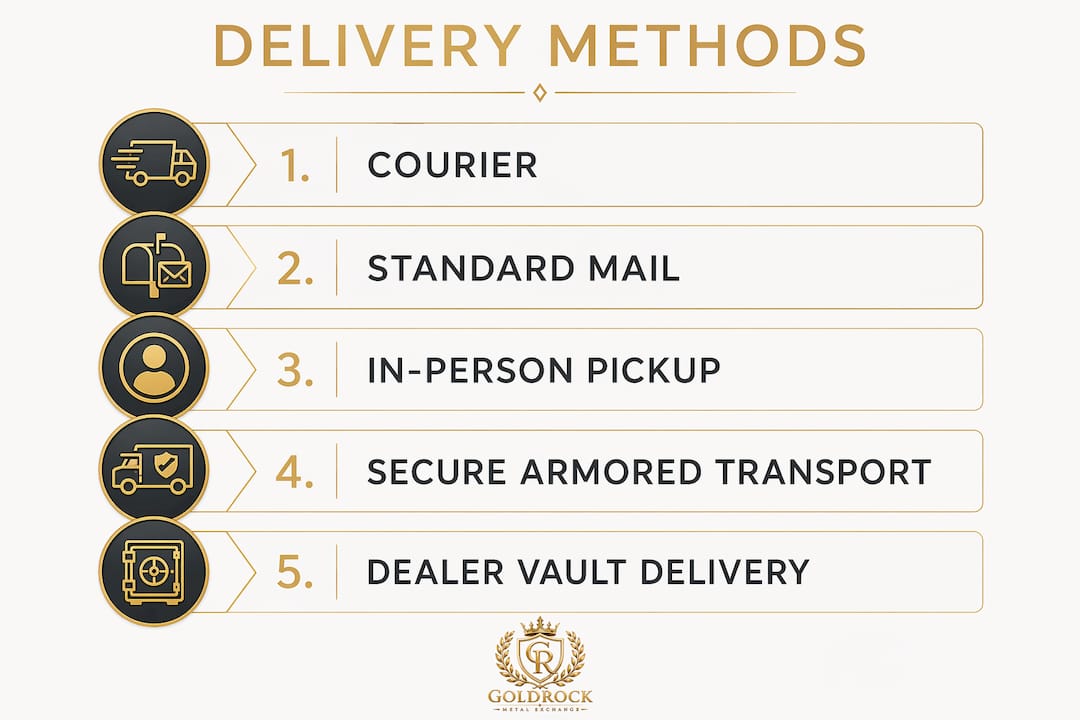
The industry uses four primary delivery channels, and each one suits a different order size and risk profile.
- Standard courier services. USPS, UPS, and FedEx are the most common carriers for retail precious metals shipments. Dealers verify the buyer’s billing address before dispatching to prevent fraud. Insurance coverage is tied to the declared value of the order, and tracking numbers are issued at the point of dispatch.
- Registered mail. Regular postal services are not recommended for precious metals unless the buyer selects an insured, trackable option such as USPS Registered Mail. Registered Mail offers declared value protection and mandatory signature confirmation, making it a viable choice for smaller orders when courier rates are prohibitive.
- Professional logistics and vault-to-vault transfer. Firms like Brink’s handle large-scale bullion movements for institutional clients. Specialized logistics providers charge roughly 0.5–2% of shipment value plus fees and include customs clearance and full insurance. This channel is the standard for six-figure or larger purchases.
- Personal transport. Buyers may carry metals personally, but this option carries legal reporting obligations. Any monetary instrument exceeding $10,000 triggers federal disclosure requirements, covered in detail below.
Pro Tip: Always confirm that your dealer ships to your verified billing address. Carriers and insurers use address verification as a primary fraud control, and a mismatch can delay or void your shipment.
The right method depends on three factors: the dollar value of your order, your location relative to the dealer, and whether you need the metals delivered to a home address or a secure storage facility. For most individual buyers purchasing physical gold or silver under $50,000, a standard insured courier with signature confirmation is the practical choice.

What security measures protect your shipment in transit?
Discreet, unmarked packaging is the first line of defense in precious metals shipping. Dealers use unmarked boxes with no indication of contents to protect buyer privacy and reduce theft risk. A package labeled “gold bullion” is a target. A plain brown box with a generic return address is not.
Signature-on-delivery is the second critical control. All insured precious metal deliveries require signature confirmation upon receipt. This creates a documented chain of custody from the dealer’s warehouse to your hands. Without a signature requirement, a carrier can leave a package unattended, and your insurance claim becomes significantly harder to process.
Real-time tracking is the third layer. Buyers receive tracking numbers and courier information as soon as the shipment is dispatched. That transparency lets you monitor the package and plan to be present at delivery. Missing a delivery attempt on an insured metals shipment is more than an inconvenience. It creates a gap in the custody record.
- Confirm the package requires a signature before it ships.
- Monitor tracking updates daily once the shipment is in transit.
- Inspect the package for damage before signing the delivery receipt.
- Photograph the sealed package and the opened contents immediately after receipt.
“The moment you sign for a damaged package without noting the damage, you may forfeit your right to a full insurance claim. Always inspect before you sign.”
Pro Tip: If you cannot be present for delivery, arrange for the carrier to hold the package at a secure facility for pickup. Never redirect a precious metals shipment to an unverified address.
How does insurance protect your precious metals shipment?
Insurance for precious metals shipments covers the full declared value of the order in the event of loss, theft, or damage during transit. Dealers and carriers tie insurance coverage directly to the declared shipment value, so undervaluing your order to save on premiums leaves you exposed to a partial recovery at best.
The two main insurance structures are carrier-provided coverage and dealer-covered policies. Carrier-provided coverage is built into the shipping label cost and typically covers standard loss or damage. Dealer-covered policies, like those offered by Goldrockmetalexchange, extend protection through the dealer’s own insurer and often provide broader coverage terms. Dealer policies frequently cover theft from a porch or mailbox, which standard carrier insurance does not.
| Coverage type | What it covers | Key limitation |
|---|---|---|
| Carrier basic coverage | Loss or damage in transit | Low per-package value caps |
| Carrier declared value | Full declared value in transit | Requires accurate value declaration |
| Dealer-covered policy | Loss, theft, and damage end-to-end | Terms vary by dealer |
| Third-party shipper insurance | Supplemental coverage for high-value orders | Additional premium required |
Filing a claim requires documentation. Keep your purchase receipt, the tracking record, photographs of any damage, and the original packaging. Submit the claim promptly. Most carriers impose a filing window of 30–60 days from the delivery date, and missing that window closes your claim permanently.
- Declare the full market value of your metals, not the purchase price alone if spot prices have risen.
- Ask your dealer whether their policy covers theft after delivery confirmation.
- Retain all packaging materials until the claim is resolved.
What legal requirements apply to precious metals delivery?
U.S. law treats certain precious metals as monetary instruments, and that classification creates reporting obligations. FinCEN Form 105 is required for any person transporting monetary instruments exceeding $10,000 across U.S. borders. Legal tender gold and silver coins can qualify as monetary instruments and may trigger this requirement even when their metal value is below the threshold.
The distinction between bullion bars and legal tender coins matters at customs. Bars are generally treated as commodities. Legal tender coins, such as American Gold Eagles, carry a face value that can classify them differently under customs rules. Reporting obligations vary by jurisdiction and item type, so buyers importing metals from overseas should verify requirements with a customs broker before shipment.
The consequences of noncompliance are severe. Improper documentation or undeclared shipments risk civil asset forfeiture, meaning customs authorities can seize your metals even if you can prove ownership. Recovering seized assets through legal channels is expensive and time-consuming.
- Declare all metals accurately on customs forms, including weight, purity, and declared value.
- Use a licensed customs broker for any international precious metals shipment.
- Keep purchase documentation with the shipment for customs inspection.
- Consult a tax professional if you are importing metals as part of a self-directed IRA rollover.
How to prepare, choose, and safely receive your shipment
A smooth delivery starts before you place the order. Verify your dealer’s credentials, confirm they carry insurance on outbound shipments, and request written confirmation of the delivery method and carrier before payment clears. Goldrockmetalexchange provides this information upfront, which is the standard every buyer should expect.
- Verify your billing address matches your delivery address. Carriers and dealers use address verification to prevent fraud. A mismatch can delay shipment or trigger a security hold.
- Select your delivery method based on order value. Orders under $10,000 typically ship via insured courier. Orders above that threshold warrant a conversation with your dealer about professional logistics options.
- Confirm insurance coverage in writing. Ask the dealer to confirm the insured value and the policy terms before the package ships.
- Monitor tracking daily. Log into the carrier’s tracking portal each morning once the shipment is in transit. Know the expected delivery window and plan to be home.
- Inspect before signing. Check the outer packaging for damage, cuts, or tampering. Note any damage on the delivery receipt before the driver leaves.
- Photograph everything immediately. Take photos of the sealed package, the opened package, and the contents. Store these with your purchase receipt.
- Store metals securely within hours of receipt. A home safe rated for the weight and value of your holdings is the minimum standard. For larger quantities, consider a professional vault.
The most common mistake buyers make is signing for a package without inspecting it. The second most common mistake is discarding the packaging before a potential claim is filed. Both errors are avoidable with a simple checklist approach on delivery day. Goldrockmetalexchange’s buyer education resources walk through this process in detail for new investors.
Key takeaways
Insured, tracked delivery with signature confirmation and discreet packaging is the non-negotiable standard for safely receiving physical gold, silver, platinum, or palladium.
| Point | Details |
|---|---|
| Choose the right carrier | Match your delivery method to order value: courier for retail, specialist logistics for large orders. |
| Insist on full declared value | Undervaluing your shipment limits your insurance recovery if loss or theft occurs. |
| Signature confirmation is mandatory | All insured precious metal deliveries require signature on receipt to maintain chain of custody. |
| Know the legal thresholds | FinCEN Form 105 applies to monetary instruments over $10,000; legal tender coins may trigger reporting. |
| Inspect before you sign | Document any damage on the delivery receipt before the driver leaves to protect your claim rights. |
What I have learned about precious metals delivery after years in this space
The buyers who get burned on delivery are almost never the ones who chose the wrong carrier. They are the ones who assumed their dealer handled everything and never asked a single question about insurance terms or packaging protocols.
I have seen investors spend months researching gold spot prices and then ship a $30,000 order with basic carrier coverage that caps out at $2,500. That gap is not the carrier’s fault. It is a failure to ask one question before the order shipped.
My honest position: insist on dealer-covered insurance for every order, regardless of size. A $500 silver order deserves the same discreet packaging and signature requirement as a $50,000 gold purchase. Theft does not scale with order value. Thieves target packages, not price tags.
The second thing I would tell any buyer is to treat the delivery day like a financial transaction, because it is one. Be present. Inspect the package. Photograph everything. Sign only after you are satisfied. That five-minute process is the difference between a clean acquisition and a months-long insurance dispute.
For large orders, professional logistics firms are not optional. They are the only responsible choice. The 0.5–2% fee for specialist transport is cheap insurance against the alternative. And if your dealer cannot tell you clearly who insures your shipment and for how much, find a dealer who can.
— Blake
Goldrockmetalexchange and your secure delivery experience
Goldrockmetalexchange ships every order with full insurance coverage, discreet unmarked packaging, and mandatory signature confirmation. Every buyer receives tracking information the moment their shipment is dispatched, so you always know where your metals are.

The team at Goldrockmetalexchange verifies billing addresses on every order and works with trusted carriers to protect your purchase from warehouse to door. For investors using a self-directed precious metals IRA, the in-house IRA department coordinates delivery directly with approved custodians, removing the guesswork from a complex process. Ready to buy with confidence? Browse the full range of gold and silver products and get a clear picture of your delivery and insurance options before you commit.
FAQ
What is insured precious metals delivery?
Insured precious metals delivery is a shipping arrangement where the full declared value of a gold or silver shipment is covered by an insurance policy in the event of loss, theft, or damage during transit. The buyer receives a tracking number and must sign for the package upon delivery.
How do I track an insured precious metals shipment?
Dealers issue a tracking number and carrier information once the shipment is dispatched, allowing real-time monitoring through the carrier’s portal. Buyers should check tracking daily and plan to be present during the delivery window.
What happens if my precious metals shipment is lost or damaged?
File a claim with the carrier or dealer insurer immediately, using your purchase receipt, tracking record, and photographs of any damage as documentation. Most carriers require claims within 30–60 days of the delivery date.
Do I need to report precious metals delivery to the government?
Personal transport of monetary instruments over $10,000 across U.S. borders requires FinCEN Form 105. Legal tender coins may trigger reporting obligations even below that value threshold, so verify requirements with a customs broker for international shipments.
Why is discreet packaging important for precious metals shipping?
Unmarked packaging with no indication of contents reduces theft risk by preventing the package from being identified as high-value in transit or at the delivery address. Industry-standard practice uses plain boxes with generic return addresses for all precious metals shipments.