

Precious metals are defined as financial safe-haven assets that preserve wealth when equity markets, currencies, and economic confidence collapse. The role of precious metals in crisis is not a theory. Gold returned an average of 2% during months when the S&P 500 fell more than 5% since 2020. That number is modest on its own, but it represents positive ground when most portfolios are losing value fast. The World Gold Council and BlackRock both confirm that gold and silver behave differently from stocks and bonds during stress, making them structurally useful for investors who want protection, not just growth.
How do precious metals perform during economic downturns?
Precious metals do not move in lockstep with equities. That separation is exactly what makes them valuable during a recession or market crash. When the S&P 500 drops sharply, gold tends to hold or gain, while most other assets fall together. Gold acts as a ballast during crises, but it underperforms risk assets when markets are calm. That pattern tells you something critical: gold is not a growth asset. It is a defense asset.
Silver behaves differently. It carries a dual role as both a store of value and an industrial input, which makes its price more volatile than gold. During extreme market stress, silver may outperform gold in percentage terms, but it also falls harder during recoveries. Investors who treat silver like gold often get surprised by that volatility.

The 2026 environment adds another layer. The US dollar has depreciated approximately 9% against major developed-market currencies since January 2025. That depreciation pushes investors toward precious metals as a currency hedge, not just an equity hedge. When your dollars buy less, hard assets priced in dollars become more attractive.
Precious metals performance snapshot (2025–2026 context):
| Metal | Primary crisis role | Volatility level | Key demand driver |
|---|---|---|---|
| Gold | Portfolio ballast, currency hedge | Low to moderate | Central bank reserves, geopolitical risk |
| Silver | Store of value, industrial input | High | Industrial demand, investor sentiment |
| Platinum | Industrial hedge, store of value | Moderate to high | Automotive, hydrogen fuel cells |
| Palladium | Industrial hedge | Very high | Automotive catalytic converters |
-
Gold delivers the most consistent crisis protection across different downturn types.
-
Silver offers higher upside during extreme stress but requires tighter position sizing.
-
Platinum and palladium are more sensitive to industrial cycles than financial ones.
-
All four metals benefit from dollar weakness and geopolitical uncertainty.
What drives the safe-haven value of precious metals?
Precious metals prices depend on a complex demand structure that includes central bank reserves, geopolitical uncertainty, and industrial trends rather than traditional cash flow models. That distinction matters. You cannot value gold the way you value a stock. There are no earnings, no dividends, and no revenue. The price reflects collective confidence in the metal as a store of value.
Central banks are the largest institutional buyers of gold. When central banks accumulate gold reserves, they signal distrust in fiat currency systems. That signal reinforces gold’s monetary credibility for private investors. Monetary policy pressure is the dominant driver of safe-haven asset shifts in 2026, with geopolitical and inflation risks amplifying gold’s monetary role and silver’s industrial one.
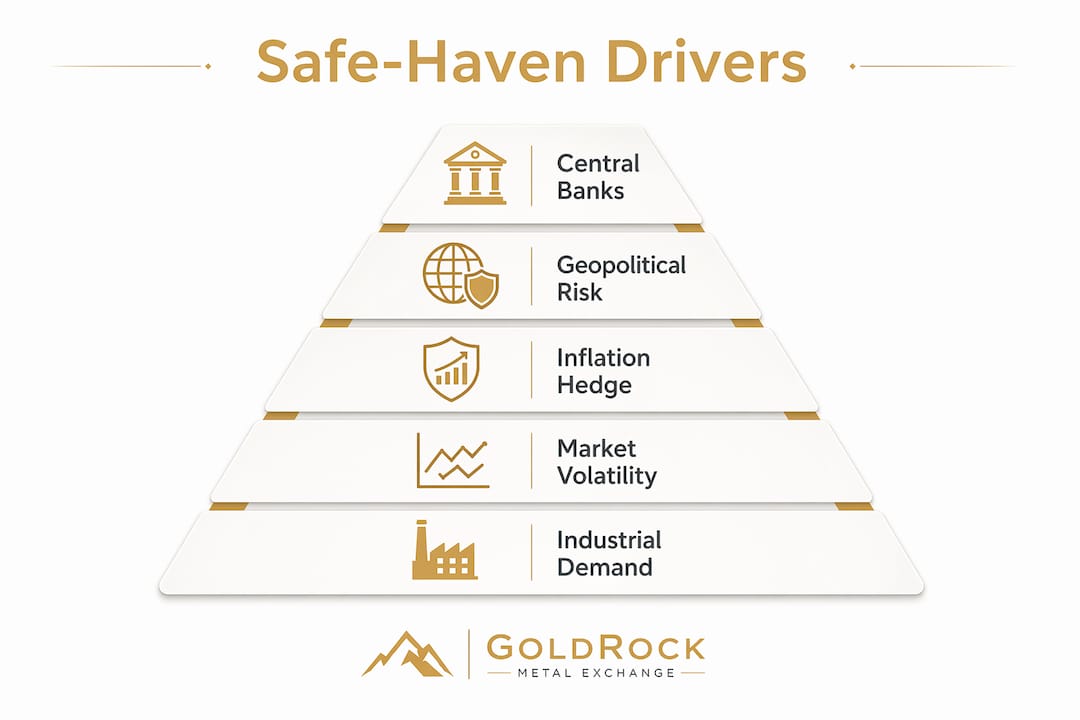
Geopolitical fragmentation also reshapes demand. Gold has evolved into a strategic portfolio component as geopolitical risks fragment global markets, particularly as bonds have weakened in their ability to protect against equity declines. Bonds used to be the default crisis hedge. That role has eroded. Gold fills the gap.
Influence factors by metal:
| Factor | Gold | Silver | Platinum |
|---|---|---|---|
| Central bank buying | Very high | Low | None |
| Inflation hedge | High | Moderate | Moderate |
| Industrial demand | Low | High | Very high |
| Geopolitical risk | High | Moderate | Low |
| Currency debasement | High | Moderate | Low |
Pro Tip: Watch central bank gold purchase announcements from institutions like the People’s Bank of China or the Reserve Bank of India. Sustained buying from those institutions historically precedes broader price appreciation.
How do gold, silver, platinum, and palladium compare as crisis assets?
Gold is the most liquid and most widely held precious metal in the world. Its liquidity during crises makes it the first choice for portfolio defense. You can sell gold quickly in almost any market condition. That liquidity is not guaranteed with other metals.
Silver is the second most recognized safe-haven metal, but its behavior is fundamentally different. Professional investors limit silver allocation because of its higher volatility relative to gold. Silver’s industrial demand, which spans solar panels, electronics, and medical devices, means its price responds to economic growth cycles as well as financial stress. That dual sensitivity cuts both ways.
Here is how the four metals break down for crisis investors:
-
Gold: Highest liquidity, lowest volatility among precious metals, the strongest track record as a monetary hedge. Best suited as the core position in any crisis allocation.
-
Silver: Higher potential returns during extreme stress, but also higher drawdown risk. Works as a secondary position, not a primary one.
-
Platinum: Tied heavily to automotive and industrial demand. Less reliable as a pure financial hedge. Useful for investors who want exposure to green energy trends alongside crisis protection.
-
Palladium: The most industrially sensitive of the four. Price swings are driven more by automotive production cycles than financial markets. Not recommended as a primary crisis hedge.
Pro Tip: A common allocation framework places gold at the core of a precious metals position, with silver as a smaller satellite holding. Keeping silver below 30% of your total metals allocation helps manage volatility without eliminating its upside potential.
What strategies and mistakes should investors watch for?
The biggest mistake investors make with precious metals is buying during panic. When markets crash and headlines are alarming, gold prices often spike. Buying during panic rallies causes overpaying, which erodes the long-term wealth preservation benefit. Disciplined, pre-crisis allocation is far more effective than reactive buying.
Here is a practical framework for crisis-aware precious metals investing:
-
Set your allocation before a crisis hits. Decide what percentage of your portfolio belongs in precious metals when markets are calm. Most financial frameworks suggest a range based on your risk tolerance, but the key is committing to a number before volatility forces your hand.
-
Choose physical bullion for long-term preservation. Physical bullion versus ETFs is a critical distinction. Physical gold and silver give you direct ownership of the asset. ETFs give you price exposure but not the metal itself. For genuine crisis protection, physical ownership matters.
-
Use ETFs for short-term liquidity needs. If you need to rebalance quickly or hedge a specific portfolio position, gold ETFs are more practical than physical metal. Physical gold carries storage, insurance, and transaction costs that make it expensive for short-term speculation.
-
Size your silver position carefully. Silver’s volatility means a large silver position can undermine the stability you are trying to create. Treat it as a complement to gold, not a replacement.
-
Review your allocation annually. Market conditions change. The 9% dollar depreciation since january 2025 has already shifted the calculus for many investors. Your allocation should reflect current macro conditions, not a decision you made three years ago.
Precious metals are conditionally safe assets, not absolute guarantees. They offer the strongest protection during extreme downturns. During mild corrections or calm markets, they often lag equities. Understanding that condition prevents disappointment and keeps your expectations calibrated.
Pro Tip: If you hold physical precious metals in a self-directed IRA, you get crisis protection and tax advantages simultaneously. Goldrockmetalexchange offers a dedicated IRA setup process that simplifies moving retirement funds into physical gold, silver, platinum, or palladium.
Key Takeaways
Precious metals protect wealth most effectively when investors allocate deliberately before a crisis, choose the right metal for their risk profile, and distinguish between physical ownership and financial exposure.
| Point | Details |
|---|---|
| Gold is the core crisis hedge | Gold averages positive returns when the S&P 500 drops more than 5%, making it the most reliable metals position. |
| Silver adds upside with more risk | Silver may outperform gold in extreme stress but requires smaller allocation due to higher volatility. |
| Dollar weakness amplifies demand | A 9% USD depreciation since january 2025 has increased precious metals’ appeal as a currency hedge. |
| Physical bullion beats ETFs for preservation | Physical ownership provides direct asset control; ETFs suit short-term hedging but not long-term crisis protection. |
| Timing and entry price matter | Buying during panic rallies leads to overpaying; disciplined pre-crisis allocation preserves wealth more effectively. |
My honest take on precious metals as a crisis tool
I have spent years watching investors treat gold like a fire extinguisher. They ignore it until the building is burning, then they grab it in a panic and pay too much. That behavior defeats the purpose entirely. The investors who actually benefit from precious metals are the ones who built their position quietly, before the headlines got scary.
The research is clear that precious metals are conditionally effective, not universally protective. Gold does not go up every time markets fall. It goes up when the stress is severe enough to shake confidence in currencies and financial systems. That is a meaningful distinction. If you are buying gold because you think a mild correction is coming, you may be disappointed. If you are buying it because you believe the structural risks in the global economy are real and persistent, the case is much stronger.
What I find most underappreciated is the currency angle. Most investors think about precious metals as an equity hedge. Fewer think about them as a dollar hedge. With the US dollar down significantly against major currencies since the start of 2025, that second function is doing real work right now. Investors who recognized that early are sitting on gains that have nothing to do with stock market volatility.
Silver is the metal I see misused most often. People buy it because it is cheaper per ounce than gold and assume they are getting a similar asset at a discount. They are not. Silver is a different animal with different drivers and much higher price swings. It belongs in a portfolio, but as a smaller, deliberate position, not as a gold substitute.
The bottom line is that precious metals work when you use them correctly. That means buying before the crisis, sizing appropriately, choosing physical ownership for real protection, and staying patient through the calm periods when metals underperform. That discipline is harder than it sounds, but it is what separates investors who benefit from metals from those who just talk about them.
— Blake
Goldrockmetalexchange: physical metals and IRAs for crisis protection
Protecting your wealth with precious metals starts with access to the right products and the right guidance. Goldrockmetalexchange is a full-service precious metal dealer that helps investors acquire physical gold, silver, platinum, and palladium with insured private delivery.

For investors who want to combine crisis protection with retirement planning, Goldrockmetalexchange offers a dedicated in-house IRA department that simplifies moving retirement funds into physical metals. You can browse the full range of physical metals products or explore the self-directed IRA options to find the approach that fits your situation. The team provides personalized consultations so you understand exactly what you are buying and why it fits your portfolio before you commit.
FAQ
What is the role of precious metals in a financial crisis?
Precious metals act as safe-haven assets that preserve wealth when equity markets and currencies decline. Gold and silver are conditionally protective, offering the strongest defense during extreme market stress rather than mild corrections.
Are precious metals recession-proof?
Precious metals are not recession-proof in an absolute sense. Gold delivers its strongest performance during severe downturns, but it can underperform during mild recessions or when markets recover quickly.
How do precious metals protect wealth during inflation?
Gold and silver act as inflation hedges because their value is not tied to any single currency. When the US dollar loses purchasing power, as it did with a 9% depreciation since january 2025, precious metals priced in dollars typically rise in value.
Is silver a safe investment during a crisis?
Silver offers crisis protection but carries significantly higher volatility than gold. It may outperform gold during extreme stress, but professional investors keep silver as a smaller secondary position rather than a primary crisis hedge.
How much of my portfolio should be in precious metals?
The right allocation depends on your risk tolerance and investment timeline. Most frameworks treat gold as the core position and silver as a smaller complement, with the total precious metals allocation sized to provide stability without sacrificing growth potential in calmer markets.