
Gold IRAs themselves are legitimate retirement vehicles, but scammers exploit rollovers with high-pressure tactics and inflated markups. Before moving a dollar of retirement money, get written fees, confirm the custodian’s identity, and secure the dealer’s buyback policy in writing. Check any dealer against the CFTC, SEC, and FINRA registries, and report anything suspicious immediately.
TL;DR:
- Dealers may charge markups up to 300% over market value, making it crucial to compare the dealer’s price against the current spot price and weight of the metal.
- Avoid offers that emphasize free gold, guaranteed returns, or vague storage claims, and demand written confirmation of all promises and fees before proceeding.
- Gold IRA metals must be stored at an IRS-approved depository with a verified custodian; never store IRA metals at home or in personal safes.
- High-pressure tactics often involve manufactured urgency, such as limited-time offers or exclusive coin releases, which should be challenged by requesting written details and taking time.
- Document all communications and verify registration status with regulatory bodies before any rollover or purchase to reduce the risk of fraud and ensure compliance.
Table of Contents
- What Are the Warning Signs of a Gold IRA Scam?
- How Much Do Dealer Markups and Fees Really Cost You?
- What Does Compliant Gold IRA Custody Look Like?
- How Do Scammers Pressure You, and What Should You Say Back?
- What Should You Do If You Suspect Gold IRA Fraud?
- How a Documented Custody Process Reduces Rollover Risk
- Request a Free Precious Metals Consultation
- Where to Verify Claims and Report Fraud
- Sources
- FAQ
What Are the Warning Signs of a Gold IRA Scam?
Most gold IRA scams share a playbook. Once you recognize the pattern, the pitch stops sounding urgent and starts sounding like a script.
The CFTC’s fraud advisory documents cold calls built around manufactured urgency: an “imminent” market crash, a currency collapse, or a limited-time window that closes the moment you hang up. That pressure is the tactic, not a market fact.
Here’s what else shows up repeatedly in enforcement cases and investor complaints:
- Free or bonus gold offers. No dealer gives away metal for nothing. Those “bonus coins” get baked into an inflated purchase price you never see broken out.
- Guaranteed returns or secret tax loopholes. No IRA structure guarantees appreciation, and there’s no undisclosed IRS loophole a salesperson has access to that your custodian doesn’t.
- Push toward collectible or semi-numismatic coins. These carry far higher markups than standard bullion, and many aren’t IRA-eligible at all, a pattern the CFTC flags directly in its “Lies Versus Facts” guidance.
- Vague or shifting storage claims. If a rep can’t name the depository or dodges questions about where your metal physically sits, that’s a problem, not a detail to sort out later.
- Home storage IRA pitches. The IRS doesn’t allow you to store IRA-owned bullion at your house. Any dealer suggesting otherwise is steering you into a compliance violation.
Pro Tip: Write down the exact promise made on the call, including any deadline mentioned. Legitimate offers don’t expire in 24 hours, and a documented promise makes any later complaint far easier to prove.
How Much Do Dealer Markups and Fees Really Cost You?
The gap between what you pay and what your metal is actually worth is called the dealer spread, and it’s where most of the damage happens. The CFTC has documented cases where markups ranged from a modest premium up to several hundred percent over melt value, and one enforcement review found retirees charged as much as 300% over market price for certain coins.
You can check the math yourself in four steps:
- Look up the current spot price per ounce for the metal you’re buying.
- Multiply spot price by the coin’s exact weight in troy ounces.
- Compare that number to the dealer’s quoted price.
- Divide the difference by the melt value to get your premium percentage.
A reasonable premium on standard bullion coins is a small single-digit percentage. Anything approaching double digits deserves a direct question about why.
By the Numbers: Regulators have documented gold IRA markups ranging from modest premiums to as high as 300% above market value in enforcement cases involving retirees.
Beyond the purchase price, watch for recurring storage, insurance, and administrative fees that stack up over years, along with financing traps like margin calls or “phantom loan” structures that put you on the hook for money you never actually borrowed. Before you commit, get the dealer’s buyback price in writing and, for any large rollover, consider an independent appraisal.
What Does Compliant Gold IRA Custody Look Like?
IRA-owned metal has to sit with a custodian or trustee and be stored at an approved depository. It cannot live in your home safe or a personal safe deposit box, a rule the IRS spells out explicitly for nonbank trustees and custodians.
Before you transfer a dollar, request the following in writing:
- The custodian’s full legal name and account number tied to your holdings
- The specific depository location where your metal will be stored
- A direct contact number for the depository, independent of the dealer
- Confirmation that the coins or bars purchased meet IRS eligibility rules
Your account statements should show melt value and exact weight for every item held, figures you can reconcile against spot price using the same math from the previous section. If a dealer describes “insured private delivery” for a rollover into an IRA, ask for the insurance certificate and depository receipt. Vague answers about storage location are a signal to slow down, not proceed.
How Do Scammers Pressure You, and What Should You Say Back?
The sales scripts behind gold IRA fraud rely on urgency and flattery: “This offer is only available today,” “You’ve been selected for an exclusive coin release,” or “Other clients like you are already moving their 401(k).” The FTC notes that free seminars and high-pressure upsells are standard tools in investment fraud generally, and gold IRA pitches borrow the same structure.
“Exclusive” or “special” coin offerings deserve particular suspicion in an IRA context, since many aren’t eligible for retirement accounts at all.
Here’s language that shuts the pressure down:
- “Send me the full fee schedule in writing before we discuss anything else.”
- “Give me the custodian’s name and direct contact number.”
- “I need time to verify this independently. I’m not authorizing any transfer today.”
- “I’m not moving funds until I have a written buyback policy.”
Pro Tip: If a representative refuses to put fees or custodian details in writing, or grows impatient when you ask for time, end the call. That reaction alone tells you what you need to know.
What Should You Do If You Suspect Gold IRA Fraud?
Move fast, but move in order. Documentation now protects you later, whether you’re disputing a purchase or reporting fraud to regulators.
- Stop any pending transaction or fund transfer immediately.
- Collect every communication: emails, call recordings, texts, and marketing materials.
- Request written contracts, invoices, and receipts for anything already purchased.
- Contact your custodian directly (not through the dealer) and request full account statements.
- Verify the dealer’s registration status independently before any further contact.
For reporting, use these channels:
- File a complaint with the CFTC if the pitch involved commodities or futures-style claims.
- Submit a tip to the SEC for securities-related concerns.
- Check broker-dealer registration and file complaints through FINRA.
- Report general fraud at reportfraud.ftc.gov.
- Contact your state Attorney General’s consumer protection office for state-level restitution options.
Some card purchases may qualify for a chargeback if reported quickly, so acting within days rather than weeks matters.
How a Documented Custody Process Reduces Rollover Risk
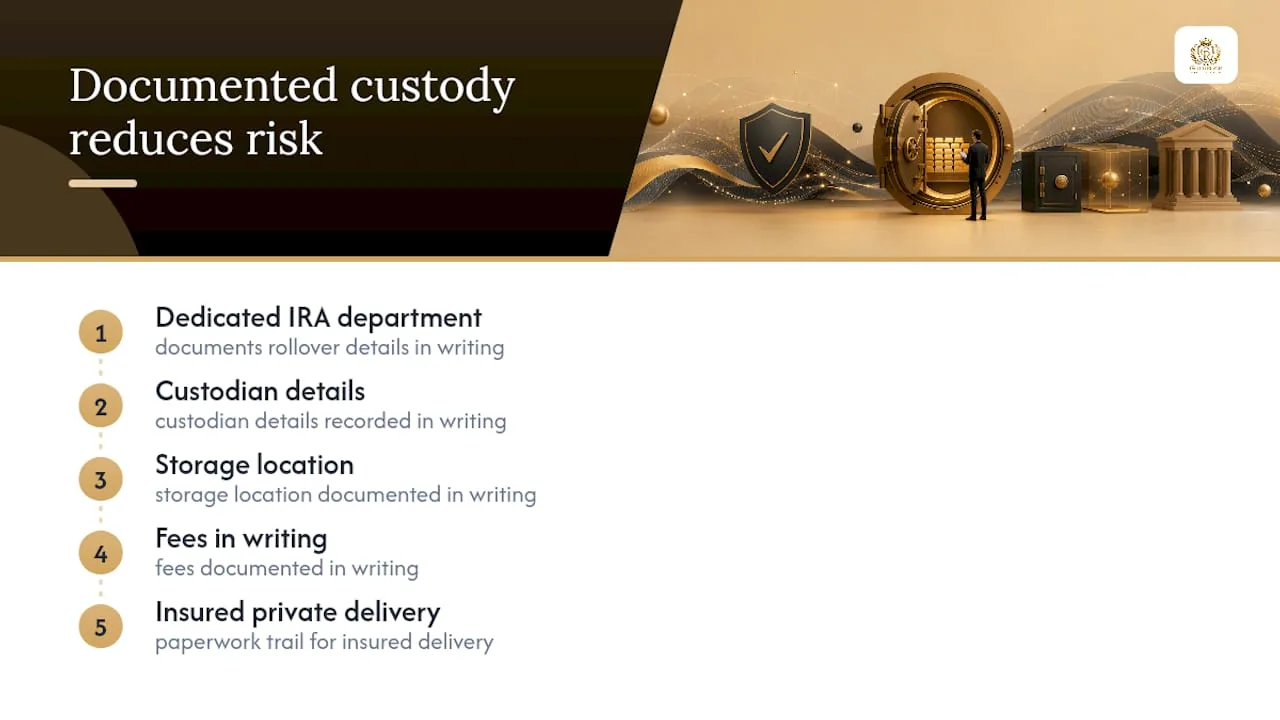
Most of the risk in this article traces back to one thing: verbal promises instead of paperwork. A rollover handled by a dedicated IRA department that documents custodian details, storage location, and fees in writing removes the ambiguity scammers depend on. Insured private delivery options work the same way: the paperwork trail is the protection, not a sales pitch.
This section reflects editorial analysis, not personalized investment, tax, or legal advice. Consult a licensed financial or tax professional before making retirement account decisions.
Request a Free Precious Metals Consultation
GoldRock Metal Exchange exists for the exact problem this article covers: retirement decisions where the paperwork matters more than the pitch. Every fee gets disclosed in writing, every custodian relationship gets documented, and every rollover runs through a dedicated in-house IRA team rather than a generic call center script.

If you’re considering a self-directed precious metals IRA, GoldRock’s team walks through custodian verification, storage confirmation, and a full written fee schedule before any funds move. For readers who want a second opinion on the numbers, an independent financial planner can also review a proposed rollover before you sign anything.
Request a Free Precious Metals Consultation by calling (888) 859-0978, or start with GoldRock’s current product pricing to see what transparent, written quotes actually look like.
Where to Verify Claims and Report Fraud
For registration checks, start with FINRA’s investor bulletin on questions to ask before buying metals. The CFTC’s advisory page covers fraud patterns and complaint filing, while its full guidance PDF breaks down common lies dealers tell. The IRS custodian list confirms which trustees are approved to hold IRA metals, and reportfraud.ftc.gov is the fastest path to file a general fraud complaint.
This article provides general educational information and is not personalized investment, tax, or legal advice.
This article is general information, not a substitute for advice from a qualified financial advisor. Consult a qualified financial professional about your own circumstances before acting on anything here.
Sources
- Precious Metals Fraud (CFTC)
- Investor Bulletin: 10 Things to Ask Before Buying Physical Gold, Silver or Other Metals (FINRA)
- Investment scams (FTC)
- Approved nonbank trustees and custodians (IRS)
FAQ
Are gold IRAs legitimate?
Yes. Gold IRAs are legal, IRS-recognized retirement accounts, but the IRS restricts which coins qualify and requires an approved custodian and depository, rules that scammers routinely ignore or misrepresent.
What are some of the most common gold IRA scams right now?
Current schemes include free-gold rollover promotions, fake urgency around economic collapse, pressure to buy non-eligible collectible coins, vague overseas or home storage claims, and phishing contacts impersonating known custodians.
What are some common gold scams to avoid?
Avoid any offer involving guaranteed returns, secret tax loopholes, unsolicited cold calls demanding immediate transfers, and dealers who won’t provide a written fee schedule or buyback policy before you buy.
Who is the best gold IRA company?
The right choice is a full-service dealer that documents fees, custodian details, and storage location in writing rather than relying on verbal promises. GoldRock Metal Exchange structures its self-directed IRA process around exactly that kind of documentation.
What should I ask a gold IRA dealer before transferring funds?
Ask for the full fee schedule in writing, the custodian’s name and contact information, the depository location, and a documented buyback price, then take time to verify each detail independently before authorizing any transfer.