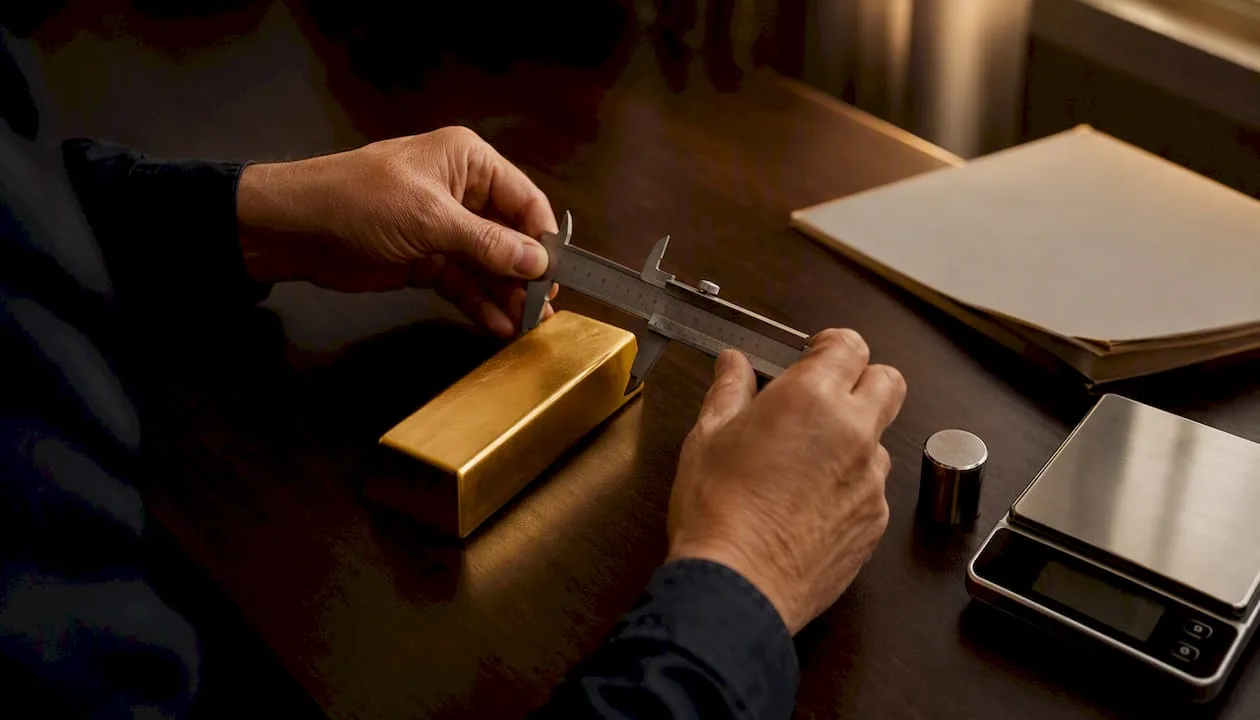
When a gold delivery arrives, authenticate it immediately with this five-step intake sequence: inspect tamper-evident seals and the assay card, confirm serial numbers match the packaging, weigh and measure against published mint specs, run a magnet and acoustic ping screen, and arrange XRF testing for any piece worth more than a few hundred dollars. That sequence catches the vast majority of counterfeits before you sign anything.
- Check tamper-evident seals and assay card before opening the outer package.
- Match the serial number on the item to the number printed on the assay card and shipping manifest.
- Weigh and measure with a 0.01 g precision scale and digital calipers; compare to U.S. Mint bullion specifications or LBMA Good Delivery standards.
- Run a neodymium magnet across the surface and perform an acoustic ping test.
- For any piece valued above a few hundred dollars, arrange professional XRF testing before finalizing acceptance.
Accept the delivery if all five checks pass and the paperwork is intact. Refuse it, on the spot if possible, if seals are broken, serials don’t match, or weight is off by more than a fraction of a gram. GoldRock Metal Exchange’s insured private-delivery service includes chain-of-custody documentation that makes this intake process straightforward.
Pro Tip: Film an uncut, continuous video from the moment you pick up the package through every check. That footage is your strongest evidence if a dispute arises later.
Key Takeaways
Authenticating delivered gold comes down to one principle: document first, test in layers, and escalate proportionally to the piece’s value.
| Point | Details |
|---|---|
| Start with the intake sequence | Check seals, match serials, weigh and measure against mint specs before accepting any delivery. |
| Layer your tests | Visual and magnet checks first, then density, then professional XRF for pieces worth more than a few hundred dollars. |
| Preserve all packaging | Intact assay packaging protects resale value and is your primary evidence if a dispute arises. |
| Escalate based on value | Small sealed bars need a serial match and weight check; bars 100 g and larger warrant professional XRF plus ultrasound. |
| GoldRock Metal Exchange | Offers insured private delivery with chain-of-custody documentation; call (888) 859-0978 for a free consultation. |
Table of Contents
- How to Authenticate Delivered Gold at the Moment It Arrives
- Five Reliable Non-Destructive Tests You Can Do at Home
- What Professional Testing Options Actually Tell You
- What Hallmarks, Karat Stamps, and Assay Cards Actually Mean
- What to Do If the Delivered Gold Looks Fake
- Typical Costs and Turnaround Times for Authentication
- When to Use a Trusted Dealer or Certified Assayer
- The Part Most Buyers Get Wrong
- GoldRock Metal Exchange: Insured Delivery and Authentication Support
- Sources
How to Authenticate Delivered Gold at the Moment It Arrives
The delivery moment is your best window. Once you sign and the courier leaves, your leverage shrinks considerably. Have your tools ready before the package arrives: a 0.01 g digital scale, calipers, a strong neodymium magnet, and the seller’s manifest or invoice.
Set up your environment first
Work on a clean, padded surface under good natural or bright artificial light. Start your phone camera recording before you touch the package, and keep it running without cuts. That uncut video is critical for IRA physical deliveries, where a documented intake sequence protects chain-of-custody and supports any future claim.
Inspect the outer packaging and tamper-evident seals
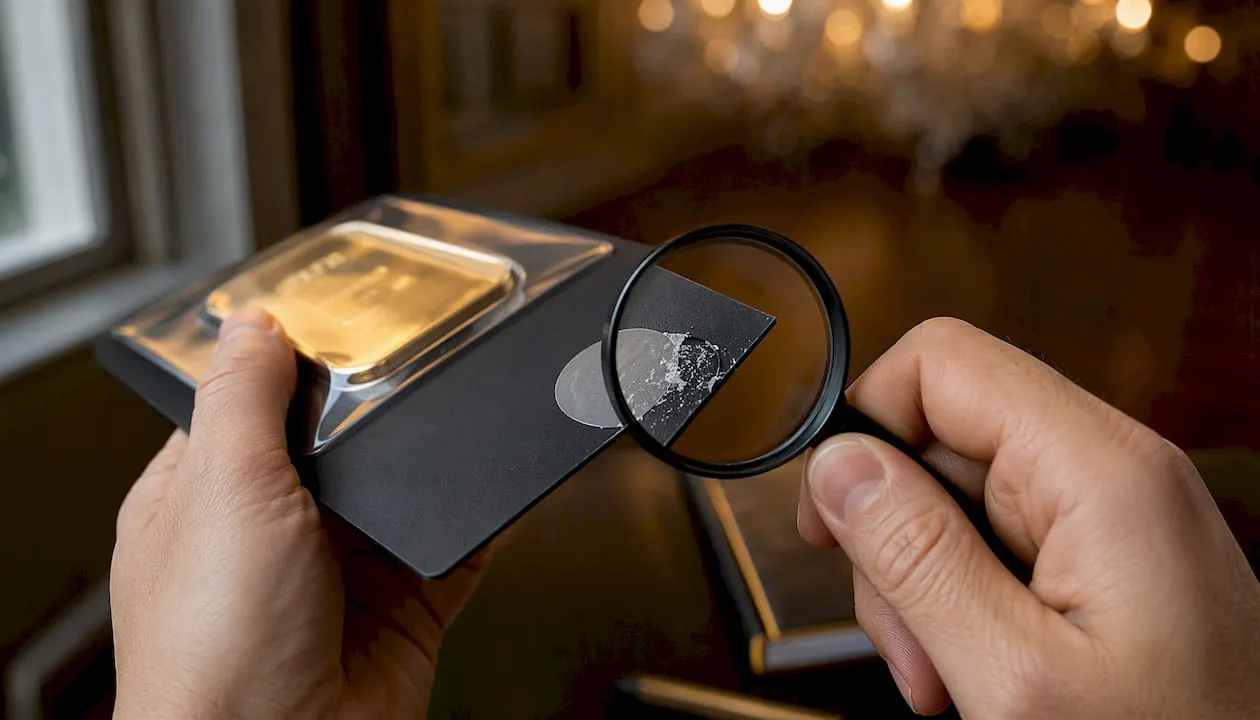
Look for signs of resealing: misaligned tape, adhesive residue in odd places, puncture marks, or a heat-seal that looks re-fused. A legitimate sealed bar or coin capsule from a reputable refiner will have a factory-consistent seal with no bubbling or peeling. If the outer box shows impact damage, photograph it before opening.
Check the assay card and serial numbers without breaking seals
For sealed bars, the serial number is typically laser-etched on the bar and printed on the assay card’s face. Hold the card up to the light and compare both numbers before you open anything. Assay cards and tamper-evident packaging provide traceability, but they can be counterfeited, so treat a matching serial as a necessary first screen, not a final verdict.
Weigh and measure against published specifications
This is where most casual fakes fail. The U.S. Mint publishes exact weight, diameter, and thickness for every bullion coin it produces. The LBMA Good Delivery standard specifies weight tolerances for bars. A genuine 1 oz American Gold Eagle weighs about 34 grams; a genuine 1 oz Gold Buffalo weighs about 31 grams. Anything significantly off is a red flag worth investigating. Use calipers for diameter and thickness; a tungsten-core fake will often pass a weight check but fail on density once you do the water-displacement math.
- Coins: compare weight, diameter, and thickness to mint specs.
- Bars: compare weight and dimensions to the refiner’s published tolerances.
- For larger or unpackaged bars, insist on professional XRF plus ultrasound before accepting.
Quick physical screens at delivery
Run the magnet slowly across every face of the piece. Gold is not magnetic; a strong pull indicates iron or steel content. A slight drag can indicate other non-gold metals. The ping test is simpler than it sounds: hold a coin loosely between two fingers and tap it gently with another coin. Pure gold rings with a clear, sustained tone for about one second. Base-metal fakes produce a dull thud.

If any screen fails, stop. Do not proceed to the next check as though the failure didn’t happen. Note it, keep the item in its packaging, and move to the refusal or dispute process.
What to say to the courier
Keep it brief and factual. Something like: “I need to note a discrepancy before I sign. I’m documenting this now.” You are not required to accept a delivery that shows signs of tampering or fails a weight check. Most carriers have a refusal protocol; ask for a refusal receipt and keep your copy.
Pro Tip: Keep a printed reference card with the specs for your specific coins or bars taped inside your intake kit. Fumbling for specs on a phone while a courier waits is how mistakes happen.
Five Reliable Non-Destructive Tests You Can Do at Home
These tests are for after the courier leaves, when you have time and a stable workspace. None of them are definitive on their own, but together they form a strong screening layer before you commit to professional testing.
1. Visual inspection and hallmark reading
What it proves: Confirms the piece carries the correct stamps; catches obvious surface fakes and plating wear.
Main limitation: Stamps can be forged; plating can look perfect to the naked eye.
On coins, look for sharp, consistent relief on the design elements. On bars, check the refiner’s logo, fineness stamp, and serial number for crisp edges. On jewelry, inspect clasps, bails, and solder points, where plating wears first and base metal shows through as a greenish or brassy tinge.
Fineness equivalents: 375, 585, 750, 916, 999, 999.9. A piece stamped 999.9 that weighs less than its stated weight is almost certainly not what it claims to be.
2. Magnet test
What it proves: Quickly eliminates ferrous-core fakes.
Main limitation: Does not catch tungsten, copper, or other non-ferrous substitutes.
Hold a strong neodymium magnet (N52 grade or similar) close to the piece without touching it. Gold shows zero attraction. Any pull, even slight, means ferrous content. This test takes ten seconds and costs nothing beyond the magnet.
3. Density (specific gravity) test
What it proves: Gold’s density of 19.3 g/cm³ is nearly impossible to fake with common metals. Tungsten comes closest at 19.25 g/cm³, but most counterfeits use cheaper metals that fail this test clearly.
Main limitation: Hollow pieces, stones set in gold, and mixed-metal assemblies all skew the result.
Steps:
- Weigh the piece dry on your 0.01 g scale. Record this as Weight A.
- Fill a graduated cylinder with enough water to fully submerge the piece.
- Suspend the piece on a thin thread so it hangs fully submerged without touching the sides. Weigh it again while submerged. Record this as Weight B.
- Calculate: Density = Weight A ÷ (Weight A minus Weight B).
- Pure 24K gold should return approximately 19.3. A 22K piece (like an American Gold Eagle) will return approximately 17.8 due to its alloy content.
Layered testing starting with density, then escalating to XRF for professional screening, is the recommended approach for any piece where the visual and magnet checks leave doubt.
4. Acoustic ping test
What it proves: Gold’s sound speed produces a distinctive sustained ring that most base metals cannot replicate.
Main limitation: Hollow or composite pieces can mimic the ring; requires a quiet room and some practice.
Hold the coin loosely between your thumb and index finger at the very edge. Tap the rim lightly with the edge of another coin or a metal pen. A genuine gold coin rings clearly for roughly one second. A base-metal fake sounds flat and brief. This test is most reliable for coins; bars are less acoustically distinctive.
5. Ice/thermal conductivity screen
What it proves: Gold conducts heat rapidly; an ice cube placed on a gold surface melts noticeably faster than on most base metals.
Main limitation: This is a rough screen only. Several other metals also conduct heat well. Use it as a tie-breaker, not a primary test.
Place a small ice cube on a flat surface of the piece at room temperature. On genuine gold, you’ll see the ice begin melting within a few seconds. On a thick base-metal piece, the melt rate is slower and more uneven.
Pro Tip: Never file, scratch, or apply acid to a piece at home unless you accept permanent damage. For anything with sentimental or significant monetary value, stop at the non-destructive screens and take it to a professional. The cost of an XRF test is almost always less than the cost of a damaged piece.
What Professional Testing Options Actually Tell You
Home tests narrow the field. Professional tests close it. For anything worth more than a few hundred dollars, the combination of XRF plus specific gravity is the standard starting point; for very high-value items or legal disputes, a fire assay is the definitive answer.
- XRF (X-ray fluorescence): Non-destructive, reads elemental composition from the surface, and produces results in minutes. It catches most sophisticated fakes, including many tungsten-core bars, but it reads only the outer layer, so a thick gold plating can fool it. Combining XRF with density or ultrasound closes that gap. Best for: coins, bars, and jewelry where you need a fast, documented result without damage.
- Ultrasound testing: Sends sound waves through the piece and reads the reflection pattern. A tungsten core produces a distinctly different signature than solid gold. Typically used alongside XRF for large bars. Best for: 100 g and larger bars, or any piece where XRF alone leaves doubt.
- Fire assay: The gold standard, literally. A small sample is dissolved and chemically analyzed. It is destructive and takes days, but the result is laboratory-grade and legally defensible. Best for: high-value items, legal settlements, and estate appraisals.
- Acid test: A touchstone is scratched against the piece and acid is applied to the mark. Cheap and fast, but it damages the surface and reads only the outermost layer. Useful for scrap sorting; a poor choice for finished jewelry or investment-grade pieces.
- Electronic conductivity testers: Measure electrical conductivity, which differs by metal. Quick and inexpensive, but calibration matters and results vary by tester quality. Use as a supplementary screen, not a primary test.
Pro Tip: When you bring a piece to a coin shop or assay lab, ask specifically for a written report with the tester’s name, the method used, and the result. A verbal “looks good” is not documentation.
Request a Free Precious Metals Consultation with GoldRock Metal Exchange if you need help arranging insured testing or coordinating a professional XRF or fire assay for a delivered piece. Call (888) 859-0978.
What Hallmarks, Karat Stamps, and Assay Cards Actually Mean
A stamp or certificate of authenticity is a useful signal, not proof. Assay cards and COAs can be counterfeited, and a convincing fake stamp costs very little to produce. Treat paperwork as the first layer of a multi-layer check, never the last.
Reading karat and fineness stamps
On jewelry, stamps appear on clasps, inside ring shanks, or on bails. On bars, the fineness and refiner mark are typically struck or laser-engraved on the face. On coins, the denomination and purity are part of the die design.
What an assay card tells you and what it doesn’t
A proper assay card includes the bar’s serial number, weight, fineness, refiner name, and often a holographic or tamper-evident seal. The serial number on the card should match the number on the bar exactly, character for character. Intact packaging preserves resale value and provides a first-line authenticity anchor; a bar with broken packaging sells at a discount even if it’s genuine, because the chain of custody is broken.
What an assay card cannot tell you: whether the bar inside matches the card. That’s why the physical checks matter. Common fraud patterns include resealing a card around a different bar, or producing a convincing replica card for a plated piece.
What to inspect on bars and coins
- Bars: Check the refiner’s logo for sharpness and consistency. Look at the serial number font under magnification; genuine laser-engraved serials have clean, uniform depth. Inspect the edges for signs of casting seams or filing.
- Coins: Genuine mint coins have sharp, consistent relief. Look at the reeded edge (the ridges on the rim) under a loupe; a cast fake often shows blurring or inconsistency there.
- Jewelry: Inspect solder points and clasps, where plating wears fastest. A greenish or brassy tinge at a solder joint is a strong indicator of base metal underneath.
What to Do If the Delivered Gold Looks Fake
Document everything before you do anything else. Do not clean the piece, remove it from its packaging unnecessarily, or attempt any test that alters the surface. Your evidence is only as strong as its preserved state.
Step-by-step response sequence
- Stop the transaction if possible. If the courier is still present, note the discrepancy aloud and on camera. Do not sign acceptance.
- Photograph and video everything. Capture the outer packaging, inner packaging, the piece itself, the assay card, and every serial number visible. Time-stamp the footage.
- Record all identifying information. Write down the tracking number, courier name, driver name if available, delivery time, and your own serial-number observations.
- Seal the item in new protective wrapping without altering the original evidence. Place the piece and all original packaging in a clean zip-lock bag or envelope. Do not wash, polish, or handle the piece more than necessary.
- Keep all receipts, invoices, and tracking documentation. These establish the chain of custody from seller to your door.
- Contact the seller in writing within 24 hours. Email or certified letter creates a timestamped record.
- File a claim with the carrier if the package shows signs of tampering in transit.
- Dispute the charge with your credit card issuer or bank if you paid by card. Most issuers allow disputes for goods not as described; act within the issuer’s claim window (often 60–120 days from the statement date).
- Report to the FTC at ReportFraud.ftc.gov or your state attorney general’s consumer-protection office if you believe the fraud was intentional.
Contacting the seller
Filing a carrier claim
Your legal rights as a buyer
Consumer protection law in the United States gives you several tools. The FTC’s Mail, Internet, or Telephone Order Rule requires sellers to ship within the stated time or offer a refund. If you paid by credit card, the Fair Credit Billing Act gives you the right to dispute charges for goods that are not as described. For IRA-related deliveries, the custodian carries additional documentation obligations; consult the Gold IRA rules that govern your account before taking unilateral action on a custodial asset.
Typical Costs and Turnaround Times for Authentication
The right test depends on what the piece is worth. Spending $150 on a lab assay for a $40 piece makes no sense; skipping professional testing on a $5,000 bar to save $50 is a false economy.
Note: costs vary by region and provider. These are general ranges for planning purposes; confirm fees with your local lab or coin shop before submitting a piece.
Matching the test to the item’s value
- Low-value jewelry (under $200): Home visual, magnet, and density checks are proportionate. An acid test at a local shop adds confidence for scrap decisions.
- Coins and small bars ($200–$2,000): A local coin shop XRF screen is the right call. Bring the original packaging and assay card.
- Large bars or high-value pieces (over $5,000): XRF plus ultrasound, or a laboratory fire assay if the result needs to be legally defensible. For small sealed bars (1 g–10 g), a serial-to-card match and weight check are often proportionate; for 100 g and larger bars, professional testing is recommended.
An appraisal is not the same as a purity test. An appraiser establishes market value; a fire assay establishes elemental composition. For insurance or estate purposes, you often need both. Ask upfront which service you’re getting and request written documentation of both the method and the result.
When to Use a Trusted Dealer or Certified Assayer
Use a trusted dealer or certified assayer any time you need documented XRF or fire assay results, chain-of-custody proof, or insured transport. A verbal opinion from a friend or an unverified online guide is not documentation; a signed report from a credentialed assayer is.
What chain-of-custody documentation looks like
Proper chain-of-custody paperwork includes: unbroken factory seals from the refiner, a serial-number log that matches the bar or coin to its assay card, signed receipts at each transfer point, and a shipping manifest that matches the delivered contents. When any link in that chain is missing or broken, the piece’s provenance becomes harder to establish and its resale value can suffer.
IRA physical deliveries require a laboratory-grade intake process to preserve chain-of-custody and support claims if a discrepancy occurs. That means a controlled environment, an uncut video record, tamper-seal inspection, and scales calibrated to 0.01 g. If you’re receiving metals as part of a self-directed IRA distribution or custodial transfer, review the IRA delivery and custody implications before handling the piece, since IRS rules govern possession of IRA-held metals.
Benefits of insured private delivery
- Reduced tampering risk during transit, because the shipment moves through a controlled, documented chain.
- Built-in claims support if damage or discrepancy occurs.
- Delivery documentation that satisfies custodial requirements for IRA accounts.
- A single point of contact for questions about the shipment.
GoldRock Metal Exchange’s insured private delivery service is built around exactly this kind of documented, secure transit. When you receive metals through GoldRock, the chain-of-custody paperwork travels with the shipment.
What to bring when you use a dealer’s testing service
- Original packaging, assay card, and all shipping documents.
- Your purchase invoice or IRA distribution paperwork.
- A written list of the specific discrepancies or concerns you’ve observed.
- Ask for a written report specifying the test method, the tester’s credentials, and the result.
Pro Tip: Ask your dealer or assayer whether they use a certified precious metals advisor on staff. A credentialed professional adds a layer of accountability to the testing process that a general coin shop may not provide.
The Part Most Buyers Get Wrong
Most fraud guides focus on the fake. The more useful focus is on the process, because a solid intake process catches fakes regardless of how sophisticated they are.
The buyers who get burned are rarely the ones who skipped a specific test. They’re the ones who skipped the documentation. A piece that fails an XRF test three weeks after delivery, with no video of the intake, no preserved packaging, and no timestamped photos, is nearly impossible to dispute successfully. The seller’s position is simple: “It was fine when it left us.”
The process described in this article, from the uncut intake video through the layered physical screens to the professional XRF for high-value pieces, is not about paranoia. It’s about creating a record that protects you if something goes wrong. Most deliveries are fine. The process costs you ten minutes. The alternative, when something isn’t fine, costs you far more.
Proportional escalation matters too. A $150 silver round does not need a fire assay. A $20,000 gold bar does. Matching the test to the value of the piece is how you stay rational about this without leaving yourself exposed.
GoldRock Metal Exchange: Insured Delivery and Authentication Support
Buyers who want the intake process handled correctly from the start have a straightforward option: purchase through a dealer whose delivery service includes the documentation built in.
GoldRock Metal Exchange ships physical gold, silver, platinum, and palladium with insured private delivery and full chain-of-custody paperwork. Every shipment includes the documentation you need for a clean intake: serial-number logs, signed manifests, and tamper-evident packaging from the refiner. For buyers setting up or receiving distributions from a self-directed precious metals IRA, GoldRock’s in-house IRA department coordinates the custodial paperwork alongside the delivery, so the chain of custody is intact from purchase through receipt.
If you’ve already received a piece and need help arranging professional XRF or fire assay testing, GoldRock’s team can point you toward the right resources and walk you through the documentation process. Browse GoldRock’s product catalog to see what’s available with insured delivery, or call to discuss a specific situation.
Request a Free Precious Metals Consultation. Call (888) 859-0978.
Sources
- COA, Assay, and Authenticity — How to Verify Real Gold
- How to Verify Gold Bar Authenticity: A Buyer’s Guide
- Usmint
For local testing, start with a reputable coin shop that offers XRF on-site. For laboratory fire assay, search for an ISO-accredited precious metals assay lab in your region and ask for a written report with the assayer’s credentials. When XRF and specific gravity agree, that combination covers most scenarios short of a legal dispute; when they disagree, or when the value is high enough that certainty matters, fire assay is the right call.
This article is for educational purposes only and does not constitute investment, tax, or legal advice. Verify current regulations and consult a qualified professional before making decisions about precious metals purchases, IRA distributions, or fraud claims.
This article is general information, not a substitute for advice from a qualified financial advisor. Consult a qualified financial professional about your own circumstances before acting on anything here.