

If you inherit an IRA that holds precious metals, the account stays an IRA, not a personal stash of coins or bars. You must follow IRS distribution deadlines, often the 10-year rule, keep the metals under custodian control the entire time, and report every distribution as ordinary income rather than a capital gain.
TL;DR:
- If the owner died after 2019, designated beneficiaries without an exception generally must empty the account within ten years; eligible beneficiaries may use life expectancy payments.
- When the owner had started required distributions, beneficiaries under the ten year rule often must take annual withdrawals; otherwise, timing may be more flexible.
- Nonspouse beneficiaries generally cannot move inherited assets into their own IRAs, and taking metal personally before a proper distribution makes its full value taxable.
- Before transferring metals, verify eligible coins or bullion, approved depository storage, and a documented custody trail; home storage can disqualify the IRA.
- For required distributions, use the custodian’s current appraisal, since metal is valued at fair market value; separate inherited accounts let beneficiaries manage schedules independently.
Table of Contents
- Core IRS Rules Beneficiaries Must Follow
- How Distributions, Titling, and Tax Treatment Work for Metals
- Custody, Storage, and Compliance Rules for IRA Metals
- Immediate Steps and Common Mistakes to Avoid
- How We Support Beneficiaries of Inherited Metals IRAs
- Potential Penalties and Tax Implications Unique to Metal IRAs
- Options for Liquidation or Transfer of Metals After Distribution
- How Inherited Metals IRAs Affect Required Minimum Distributions
- A Compliance-First View on Inherited Metals IRAs
- Request a Free Precious Metals Consultation for Your Inherited IRA
- FAQ
- Sources
Core IRS Rules Beneficiaries Must Follow
The 10-year rule applies when the original account owner died after 2019 and you are a “designated beneficiary” who does not qualify for an exception. Under this rule, you must empty the inherited IRA, metals included, within ten years following the owner’s death. Publication 590-B lays out this deadline along with the beneficiary categories that change it.
Not everyone falls under the 10-year rule. The IRS carves out “eligible designated beneficiaries,” who can stretch payments over their own life expectancy instead:
- A surviving spouse, who can also choose to treat the inherited IRA as their own account.
- A minor child of the original owner, until they reach the age of majority.
- A beneficiary who is chronically ill or disabled under IRS definitions.
- A beneficiary who is not more than 10 years younger than the original owner.
Required minimum distribution timing depends on whether the owner died before or after their required beginning date. If the owner had already started RMDs, many designated beneficiaries subject to the 10-year rule still need to take annual distributions during those 10 years, not just a lump sum at the end. If the owner died before their required beginning date, the 10-year rule often allows more flexibility on timing within the window. Eligible designated beneficiaries who choose life-expectancy payments recalculate or use a fixed divisor depending on their category, a detail worth confirming with your custodian and a tax professional. The SECURE Act reshaped much of this framework, narrowing the stretch IRA strategy that once let most beneficiaries spread distributions across decades.
How Distributions, Titling, and Tax Treatment Work for Metals
Metals held in an inherited IRA do not get special tax treatment just because they are physical assets. Distributions from an inherited traditional IRA, whether in cash or in-kind metal, are taxed as ordinary income in the year you receive them. There is no step-up in basis for IRA assets, a point Publication 590-B makes clear: the tax-deferred nature of the account carries over to you as the beneficiary.
Proper titling matters from day one. Custodians typically retitle the account as a “Decedent IRA f/b/o [Beneficiary]” rather than merging it into your own IRA. This titling preserves the inherited status and keeps the distribution rules attached to the correct beneficiary.
Trustee-to-trustee transfers that establish separate inherited IRAs titled for each beneficiary allow separate RMD accounting and preserve post-death tax treatment when custodians follow proper procedures.
IRS private letter ruling 202624001 illustrates this pattern directly, showing how a trustee-to-trustee transfer into separate accounts kept each beneficiary’s distribution schedule intact.
A few mechanics to keep in mind:
- Non-spouse beneficiaries generally cannot roll an inherited IRA into their own existing IRA.
- Taking physical possession of the metal, rather than moving it custodian to custodian, counts as a taxable distribution under IRC §408(m).
- Splitting an IRA among multiple beneficiaries usually requires separate trustee-to-trustee transfers, not a single account divided informally.
Custody, Storage, and Compliance Rules for IRA Metals
Only certain metals qualify for IRA custody in the first place. Under IRC §408(m), the IRS permits specific government-minted coins, such as American Eagles, along with bullion meeting minimum fineness thresholds, generally .995 for gold and .999 for silver, when the custodian holds them on the IRA’s behalf.
As a beneficiary, you need to confirm three things before any transfer completes:
- Confirm the metals qualify. Check that coins and bars match IRS fineness and mint standards, not just retail bullion specifications.
- Confirm the storage arrangement. The metals must stay with an IRS-approved custodian in an approved depository; home storage disqualifies the IRA and can trigger a full taxable distribution.
- Confirm the paperwork trail. Request depository receipts, transfer confirmations, and assay certificates any time the metal moves between custodians or accounts.
Pro Tip: Ask your custodian for a written chain-of-custody summary before any transfer closes, it is far easier to resolve a documentation gap before assets move than after.
Our guide to investing in coins for retirement walks through which coins meet IRA rules in more detail, and our explainer on why home storage disqualifies an IRA covers the correction process if a custody mistake already happened.
Immediate Steps and Common Mistakes to Avoid
Start with the basics: contact the custodian holding the metals, secure recent account statements, and confirm how the account is titled and who the named beneficiaries are. If multiple people inherit the account, request trustee-to-trustee transfers to split it into separate inherited IRAs rather than trying to divide assets informally.
Gather paperwork early: a certified death certificate, completed beneficiary claim forms, and a clear sense of where you stand on the 10-year countdown. If the IRA is payable to the estate rather than a named individual, coordinate closely with the executor, since estate-beneficiary situations can trigger a 5-year distribution rule instead of the 10-year rule.
The 10-year rule requires most non-eligible designated beneficiaries to fully distribute an inherited IRA within ten years following the owner’s death, according to Publication 590-B. Missing that deadline carries real consequences.
- Taking physical delivery of the metal before distribution is appropriate often disqualifies the IRA entirely.
- Attempting to roll an inherited IRA into your own existing IRA is generally off-limits for non-spouse beneficiaries.
- Letting the 10-year deadline slip, or failing to set up separate inherited IRAs when multiple people inherit, creates avoidable tax exposure.
How We Support Beneficiaries of Inherited Metals IRAs
Handling an inherited Precious Metals IRA involves custodian coordination, titling accuracy, and careful timing, and our in-house IRA department works through those steps with you directly. We also offer insured private delivery for situations where a distribution calls for taking metal out of custodial storage.
- We help coordinate trustee-to-trustee transfers and account setup for inherited Precious Metals IRAs.
- We offer insured private delivery once a distribution is appropriate.
- We provide ongoing consultation to help you understand each step before it happens.
Our Precious Metals IRA page and our coin investing guide are good starting points if you want to review the details before reaching out.
Potential Penalties and Tax Implications Unique to Metal IRAs
Metal-specific penalties generally trace back to one issue: control. When a beneficiary takes physical possession of IRA-held metal instead of moving it through an approved custodian, the IRS treats that as a distribution under IRC §408(m), and the full value becomes taxable income in that year.
Because inherited IRA distributions are taxed as ordinary income rather than capital gains, a large unplanned distribution of metal can push you into a higher tax bracket for that year. There is no special metals carve-out that softens this, and no step-up in basis to reduce the taxable amount, since the asset was never held outside a tax-deferred account.
Missing the 10-year distribution window creates a separate problem. Failing to empty the account in time can result in penalties on the amount that should have been distributed. If an IRA with no clear designated beneficiary passes to an estate, the distribution timeline can shift to a 5-year rule instead, which compresses your planning window further.
None of this is intended as tax advice for your specific situation. The right move often depends on your income bracket, the account’s structure, and how many beneficiaries are involved, which is exactly the kind of question worth bringing to a tax professional before you act.

Options for Liquidation or Transfer of Metals After Distribution
Once you are legally entitled to a distribution, you generally have two paths: liquidate the metal through the custodian before it leaves the account, or take an in-kind distribution of the physical metal itself.
Liquidating inside the IRA means the custodian sells the metal and distributes cash, which simplifies recordkeeping but locks in whatever price the sale achieves at that moment. Taking an in-kind distribution means the metal itself transfers to you, at which point it is no longer an IRA asset and the fair market value on the distribution date becomes taxable ordinary income.
If several beneficiaries share one IRA, trustee-to-trustee transfers into separate inherited accounts let each person choose their own path afterward, rather than forcing one collective decision. IRS private letter ruling 202549002 illustrates how these separate transfers can preserve individual options, including rollover treatment for a surviving spouse in the right factual circumstances.
For beneficiaries who do take an in-kind distribution, our guide on private metals delivery explains how insured delivery and authentication work once metal leaves custodial storage.
How Inherited Metals IRAs Affect Required Minimum Distributions
Required minimum distributions on an inherited metals IRA follow the same framework as any other inherited IRA, the asset type does not change the math. If you are an eligible designated beneficiary using life-expectancy payments, your RMD is calculated each year based on the account balance and your applicable life-expectancy factor.
If you fall under the 10-year rule and the original owner had already begun RMDs before death, you typically need to continue taking annual distributions throughout the 10-year window rather than waiting until the final year. Valuing metal for RMD purposes requires a current custodian appraisal, since the distribution amount is based on fair market value, not the original purchase price.
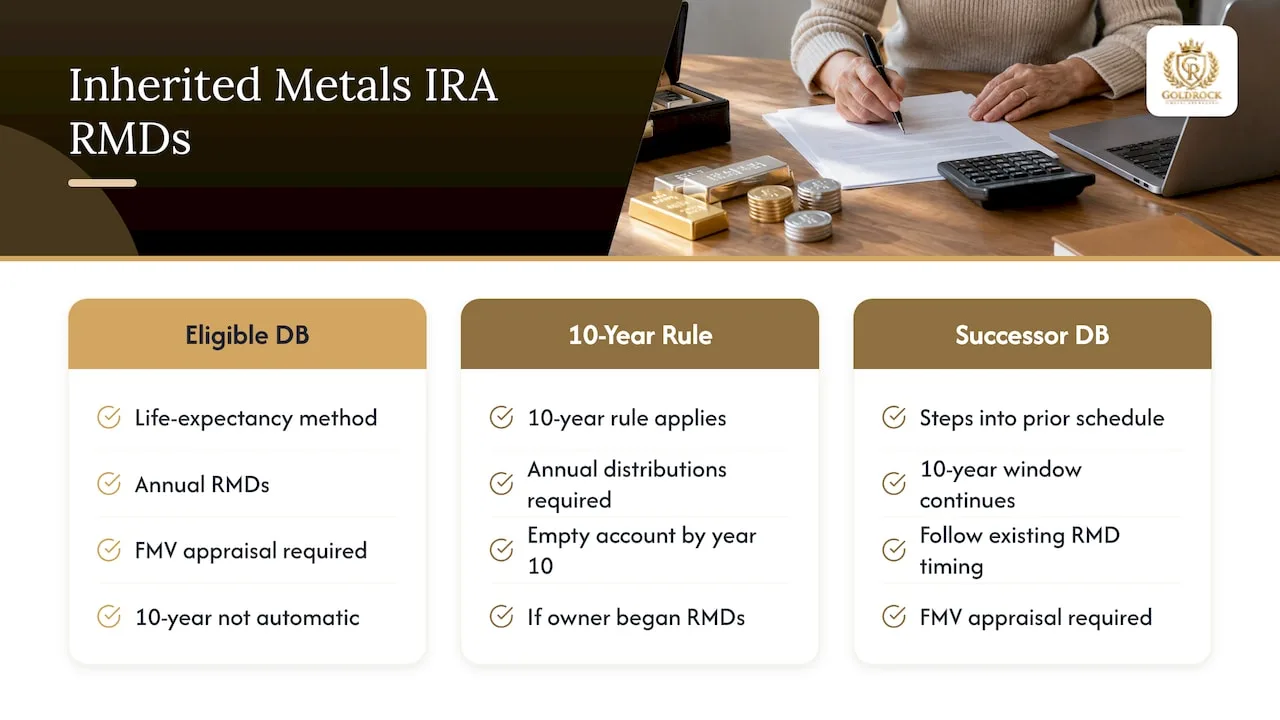
Successor beneficiaries, meaning someone who inherits from the first beneficiary, generally step into that beneficiary’s existing schedule rather than starting a fresh one. The 10-year window from the original owner’s death usually keeps running, it does not reset with each transfer, a detail confirmed across IRS guidance and the private letter rulings on this topic.
A Compliance-First View on Inherited Metals IRAs
The safest approach to an inherited metals IRA is the least exciting one: confirm titling, respect custodian control, and keep every document. This is educational information, not personalized tax or legal advice, so bring your specific situation to a qualified professional before making distribution decisions.
— Blake
Request a Free Precious Metals Consultation for Your Inherited IRA

Working through an inherited Precious Metals IRA does not have to mean guessing at IRS rules alone. Our in-house IRA department helps you confirm titling, coordinate trustee-to-trustee transfers, and set up a properly separated inherited account, with insured private delivery available once a distribution is appropriate.
- Call us at (888) 859-0978 to talk through your specific inherited IRA situation.
- Visit our Precious Metals IRA page to see how our account setup and transfer support works.
- Request a Free Precious Metals Consultation to get a clear next step for your account.
If your questions extend into broader tax planning around the distribution, our partner resource on dividend and investment tax rules offers useful background, though it is not a substitute for advice from your own tax professional.
FAQ
How do you own gold inside an IRA?
Gold held in an IRA must meet IRS fineness standards and stay in the custody of an approved trustee and depository, never in your personal possession. A self-directed IRA structure allows this kind of physical metal ownership, with the custodian handling storage and reporting on your behalf.
What are the withdrawal rules for beneficiaries of an inherited IRA?
Most non-eligible designated beneficiaries must fully distribute the inherited IRA by December 31 of the year containing the tenth anniversary of the owner’s death, under the 10-year rule. Eligible designated beneficiaries, including spouses, minor children, and certain disabled or chronically ill beneficiaries, can often stretch distributions over their own life expectancy instead.
What are the exceptions to the 10-year rule?
Eligible designated beneficiaries are exempt from the strict 10-year payout and can use life-expectancy-based distributions. This group includes surviving spouses, minor children of the account owner, individuals who are chronically ill or disabled, and beneficiaries not more than 10 years younger than the original owner, as described in Publication 590-B.
What should you do with an inherited Roth IRA?
Inherited Roth IRAs follow the same 10-year or life-expectancy distribution framework as traditional IRAs, but qualified distributions come out tax-free rather than as ordinary income. The right choice between taking distributions early or waiting depends on your personal tax situation, so this decision is worth reviewing with a tax professional rather than deciding from general rules alone.
Can you take physical possession of metal from an inherited IRA?
Taking physical possession of metal while it is still titled to the IRA counts as a distribution under IRC §408(m) and becomes taxable in that year. Metal can only leave custodial control once you are legally entitled to a distribution and the transfer is processed correctly.