

You can roll a 401(k) into a self-directed precious-metals IRA. A direct trustee-to-trustee transfer is the safest way to do it. Before you read another word, run through this short checklist:
- Confirm rollover eligibility with your 401(k) plan administrator (not all plans allow in-service rollovers).
- Open a self-directed IRA (SDIRA) with an IRS-approved custodian before requesting any transfer.
- Request a trustee-to-trustee transfer in writing so funds move directly between institutions and never touch your hands.
Never take physical possession of IRA metals during a transfer. The IRS treats personal possession as a deemed distribution, triggering immediate taxation and potentially a 10% early-withdrawal penalty if you are under age 59½. A properly completed direct rollover is generally not taxable at the time of transfer.
This article is educational and general in nature. It is not personalized tax, legal, or investment advice. Consult a qualified tax advisor or financial professional before making rollover decisions.
Key Takeaways
A direct trustee-to-trustee rollover is the single most important best practice for moving a 401(k) into a precious-metals IRA because it eliminates withholding, the 60-day deadline, and the most common tax errors in one step.
| Point | Details |
|---|---|
| Use a direct rollover | Trustee-to-trustee transfer avoids 20% withholding and the 60-day taxable distribution risk. |
| Verify IRS-eligible metals | Gold needs 0.995 fineness; silver 0.999; platinum and palladium 0.9995 (American Eagles are statutory exceptions). |
| Confirm custodian and depository | Get the depository’s name, insurance certificate, and written custodial agreement before transferring funds. |
| Get a written fee schedule | Request a full breakdown of setup, administration, storage, and dealer premium before approving any purchase. |
| GoldRock Metal Exchange | GoldRock’s in-house IRA department handles custodian coordination, documented pricing, and depository confirmation for the full rollover process. |
Table of Contents
- What are the best practices for a 401(k) rollover into metals?
- How do direct vs. indirect rollovers affect your taxes?
- Which metals qualify inside an IRA, and what purity do they need?
- Why can’t you store IRA metals at home?
- What does a 401(k) to precious-metals rollover actually cost?
- What mistakes do investors most often make with a 401(k) metals rollover?
- How GoldRock Metal Exchange supports your rollover from start to finish
- When does a rollover into metals make sense, and when should you pause?
- GoldRock Metal Exchange: your next step for a precious-metals IRA rollover
- Primary sources and references
- Sources
What are the best practices for a 401(k) rollover into metals?
The process follows a clear sequence. Skipping or reordering steps is where most costly mistakes happen. Here is the full path, from eligibility check to depository confirmation.
The step-by-step rollover process
-
Verify rollover eligibility. Contact your 401(k) plan administrator and ask two specific questions: Does the plan permit rollovers while you are still employed (in-service rollover)? Are there any outstanding loan balances that would become taxable if you roll over? Get the answers in writing.
-
Choose and open a self-directed IRA. A precious-metals IRA is a self-directed IRA in which a qualified custodian holds physical gold, silver, platinum, or palladium meeting IRS fineness standards. The Taxpayer Relief Act of 1997 and IRC Section 408(m)(3) define those requirements. Select a custodian that explicitly supports precious-metals SDIRAs, confirm their IRS approval, and complete the account application before initiating any transfer.
-
Instruct your 401(k) plan administrator to execute a trustee-to-trustee transfer. This is the critical step. The plan administrator liquidates your 401(k) holdings to cash and wires the proceeds directly to your new SDIRA custodian. You never receive a check. According to SmartAsset’s rollover guidance, the custodian opens the account, the plan administrator executes the trustee-to-trustee transfer, and the custodian then purchases IRS-approved metals. You do not transfer gold directly out of a 401(k) — the sequence is always sell-to-cash, transfer cash, then purchase metals.
-
Fund the SDIRA and submit an investment direction. Once cash arrives in the SDIRA, the custodian waits for your written investment direction before buying anything. That direction specifies the exact product (coin or bar type, weight, purity), quantity, and the dealer you have chosen. The custodian executes the purchase only after receiving that instruction.
-
Confirm depository receipt and account statements. The dealer ships directly to an IRS-approved depository. You should receive a depository confirmation showing the specific metals received, their serial or assay numbers, and the storage designation (segregated or commingled). Keep that document.
Documents and forms to gather
- 401(k) plan rollover/transfer request form
- Trustee-to-trustee transfer instruction letter (your custodian usually provides a template)
- SDIRA account application and beneficiary designation
- Investment direction letter (specifying metal, product, quantity, and dealer)
- Depository receipt and storage confirmation
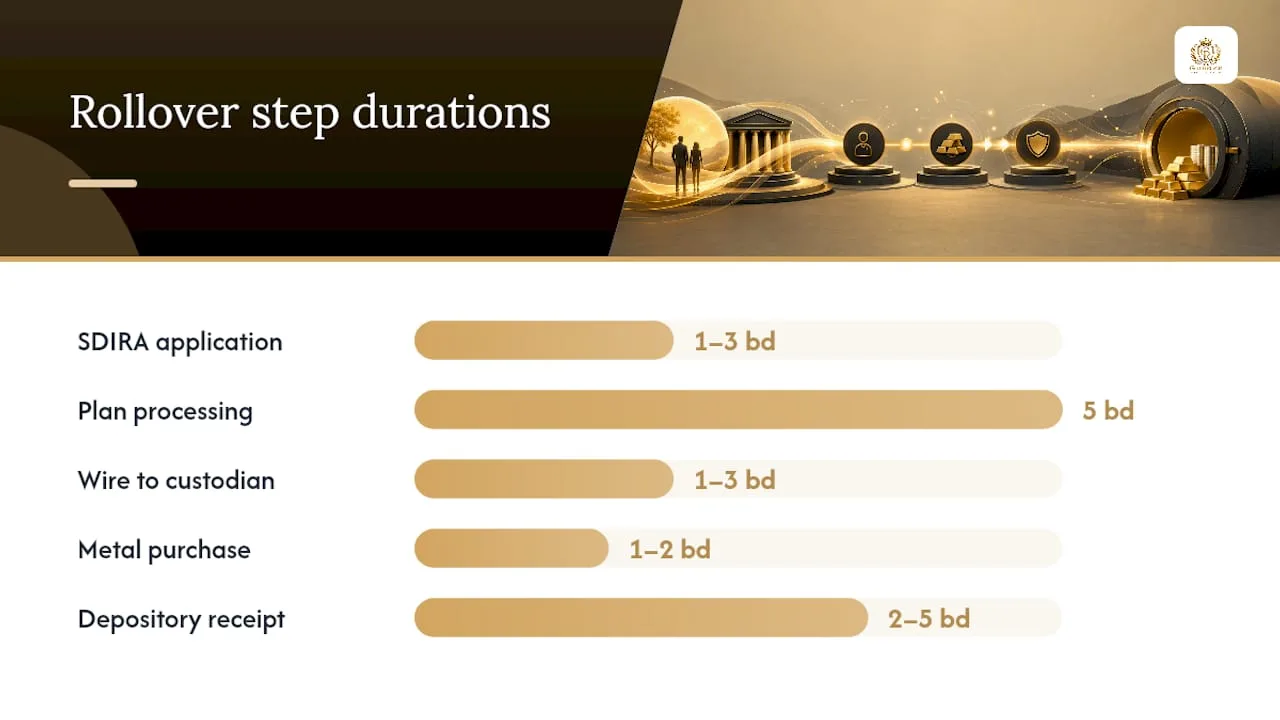
Rollover timeline
| Step | Typical Duration | Common Delays |
|---|---|---|
| SDIRA account application | 1–3 business days | Missing ID documents, incomplete beneficiary forms |
| Plan administrator processing | 5 business days | Paper forms, outstanding loan review |
| Wire transfer to custodian | 1–3 business days | Check processing adds 3–5 days |
| Metal purchase execution | 1–2 business days | Market-hours timing, investment direction errors |
| Depository receipt and confirmation | 2–5 business days | Shipping delays, depository intake queue |
Pro Tip: Request that your 401(k) plan administrator issue a wire transfer payable directly to your SDIRA custodian rather than a check payable to you. A check made out to you triggers mandatory withholding even if you intend to deposit it within 60 days.
How do direct vs. indirect rollovers affect your taxes?
The difference between a direct and indirect rollover is not a technicality. It determines whether your transfer is tax-free or whether you immediately owe money to the IRS.
Direct (trustee-to-trustee) rollover
Cash moves from your 401(k) plan directly to your SDIRA custodian. You never receive the funds. No withholding applies, and the 60-day clock never starts. This is the method every rollover guide and custodian recommends for good reason — it removes the two most common failure points entirely.
Indirect rollover
Your plan administrator sends a check to you. Miss the 60-day window and the entire distributed amount becomes taxable income.
The 60-day rule is unforgiving. The IRS does allow hardship waivers in limited circumstances, but they require a formal request and are not guaranteed. The simplest way to avoid the risk is to never trigger the clock in the first place — use a direct rollover.
Scenario callouts worth knowing
- In-service rollover: Many plans restrict rollovers while you are still employed. Some allow partial rollovers after age 59½. Ask your plan administrator for the specific plan document language, not just a verbal answer.
- Rule of 55: If you separate from service in or after the year you turn 55, you may take distributions from that employer’s 401(k) without the 10% penalty. Rolling those funds into an IRA before taking distributions removes that exception — consult a tax advisor before rolling over if you are between 55 and 59½ and may need liquidity.
- Roth conversion: Rolling a traditional 401(k) into a Roth SDIRA is a taxable event in the year of conversion. The entire converted amount is added to your ordinary income. This can make sense in certain situations, but it requires careful tax planning.
- Partial rollovers: You can roll a portion of your 401(k) into a precious-metals SDIRA and leave the rest in the plan. This preserves any plan-specific protections (such as creditor protection under ERISA) on the retained balance.
To confirm a direct rollover, ask your plan administrator to provide written confirmation that the check or wire is made payable to your SDIRA custodian “for benefit of” (FBO) your name, not to you personally.
Which metals qualify inside an IRA, and what purity do they need?
The IRS does not allow just any gold coin or silver bar inside a retirement account. IRC Section 408(m)(3) sets minimum fineness thresholds, and buying a non-qualifying product triggers a deemed distribution on the full purchase amount.
IRS minimum fineness requirements
- Gold: 0.995 fineness (99.5% pure). Exception: the American Gold Eagle coin is IRS-eligible despite its 0.9167 fineness because Congress specifically authorized it under the Taxpayer Relief Act of 1997.
- Silver: 0.999 fineness (99.9% pure). The American Silver Eagle qualifies.
- Platinum: 0.9995 fineness. The American Platinum Eagle qualifies.
- Palladium: 0.9995 fineness. The American Palladium Eagle qualifies.
Coins must be produced by a national government mint or meet the fineness standard above. Collectibles, numismatic coins, and most pre-1933 gold coins do not qualify. When in doubt, ask your custodian for their approved product list before placing an order.
Documentation checklist for each purchase
- Refiner or assayer certificate confirming purity
- Serial or assay number (required for bars; serialized coins carry their own identification)
- Product description matching the custodian’s approved list (weight, fineness, mint of origin)
- Dealer invoice showing spot price, premium percentage, and total per-ounce cost
- Depository receipt confirming the specific product received
Coin vs. bullion bar: what matters for an IRA
The coin-vs.-bullion question for retirement accounts comes down to three practical factors: premium, liquidity, and custodian acceptance. Government-minted coins (American Eagles, Canadian Maple Leafs, Austrian Philharmonics) typically carry higher premiums over spot than comparable bars but are universally recognized and easy to verify. Bars from LBMA-approved refiners (such as PAMP Suisse or Valcambi) often carry lower premiums, but you must confirm your custodian will accept the specific refiner and that the bar carries a serial number. For an IRA, the custodian’s approved product list is the deciding document — not general market preference.

Pro Tip: Before approving any purchase, ask the dealer for a written quote showing the live spot price at the time of quote, the premium as a percentage, and the total per-ounce cost. Compare that to live spot prices so you know exactly what you are paying above market. That number is your immediate cost basis above a no-premium instrument.
Why can’t you store IRA metals at home?
The IRS requires that physical metals held inside an IRA be in the possession of a qualified trustee or custodian — not the account owner. Storing IRA metals at home, in a personal safe, or through any arrangement that gives you physical access constitutes a prohibited transaction and a deemed distribution. The LegalClarity rollover guide confirms that home storage and checkbook/LLC arrangements claiming personal access to IRA metals are noncompliant and risk full account taxation when discovered.
Who does what in the custody chain
- Custodian: An IRS-approved financial institution (bank, trust company, or approved non-bank custodian) that holds legal title to the IRA assets, executes purchases per your investment direction, files required IRS reports (Form 5498, Form 1099-R), and maintains account statements.
- Dealer: Sells the physical metals to the custodian on your direction. The dealer does not hold IRA assets and has no custodial role. Ships directly to the depository.
- Depository: An IRS-approved, insured, third-party vault facility that physically stores the metals. The depository holds the metals on behalf of the custodian and issues storage confirmations.
Segregated vs. commingled storage
| Storage Type | What It Means | Cost | Best For |
|---|---|---|---|
| Segregated | Your specific coins/bars stored separately, identified by serial number | Higher annual fee | Investors who want specific-issue metals returned on distribution |
| Commingled (pooled) | Your metals stored with others’ holdings of the same type and purity | Lower annual fee | Investors prioritizing cost over specific-issue identification |

Segregated storage costs more, but it guarantees that the exact bars or coins you purchased are the ones returned when you take a distribution. Commingled storage returns equivalent metals of the same type and purity. Both are IRS-compliant when the depository is properly approved.
Checklist to confirm custodian and depository compliance
- Written custodial agreement naming the specific depository
- Depository’s name, physical address, and insurance underwriter
- Coverage limits and whether insurance covers full replacement value
- Annual IRS reporting practices (Form 5498 filing confirmation)
- Process for taking in-kind distributions or liquidating to cash
For detailed storage guidance, GoldRock Metal Exchange’s resource on storing physical gold safely covers depository options and what to verify before committing.
What does a 401(k) to precious-metals rollover actually cost?
The total cost of a rollover has two layers: one-time setup costs and ongoing annual costs. Most investors focus on the annual fees and underestimate the dealer premium, which is the largest immediate cost in the transaction.
Typical fee categories
- Custodian setup fee: A one-time charge to open the SDIRA account.
- Annual administration fee: Charged by the custodian for account maintenance, IRS reporting, and statement generation.
- Storage fee: Charged by the depository, either as a flat annual amount or as a percentage of account value. Segregated storage runs higher than commingled.
- Dealer premium over spot: The percentage above the live spot price you pay when purchasing metals. This is often the largest single cost and is paid upfront at the time of purchase.
- Transaction or brokerage fee: Some custodians charge a per-transaction fee each time you buy or sell metals within the account.
- Shipping and insurance: Covers the dealer’s cost to ship metals to the depository. Often included in the premium but worth confirming separately.
The dealer premium: the cost most investors miss
Dealer premiums are frequently the overlooked cost in a precious-metals IRA. When you purchase metals at a premium above spot, that premium is an immediate cost you must recover through metal appreciation before you are at break-even relative to a no-premium instrument. Historical gold price data can give you context for how long price recoveries have historically taken, though past price history is not a prediction of future performance.
Pro Tip: Before approving any purchase, request a written fee schedule and ask the dealer to show you a sample invoice for your rollover amount — broken down into custodian setup, annual administration, storage, dealer premium, and transaction fees. That single document tells you exactly how much of your $100,000 (or whatever amount) actually buys metal vs. covers costs.
What mistakes do investors most often make with a 401(k) metals rollover?
Most rollover errors fall into a short list of categories, and nearly all of them are preventable with the right paperwork and the right sequence.
The most common and costly mistakes
- Taking possession of the funds or metals. Any check made payable to you, or any metals shipped to your home address, triggers a distribution. Use trustee-to-trustee transfers exclusively.
- Using an indirect rollover without replacing the withheld 20%. If you accept a check and the plan withholds 20%, you must deposit the full pre-withholding amount within 60 days. Depositing only what you received leaves the withheld portion as a taxable distribution.
- Buying non-IRS-eligible products. Collectible coins, numismatic pieces, and bars from non-approved refiners do not qualify. The purchase is treated as a distribution in the year it occurs.
- Skipping custodian verification. Not all companies that call themselves “IRA custodians” are IRS-approved. Confirm the custodian is a bank, federally insured credit union, savings and loan association, or an entity specifically approved by the IRS under IRC Section 408(a).
- Ignoring the dealer premium. Approving a purchase without knowing the premium percentage means you do not know your true cost basis. Always get the written spot-plus-premium breakdown before confirming.
- Missing or incomplete documentation. A rollover without a written investment direction, a depository confirmation, or a custodial agreement creates gaps that complicate distributions, RMDs, and IRS reporting.
Red-flag questions that signal a noncompliant structure
Ask any dealer or custodian these questions. Evasive or vague answers are a warning sign:
- “Where exactly will my metals be stored, and what is the depository’s name and address?”
- “Can I see the written custodial agreement and the depository’s insurance certificate?”
- “Is this a checkbook IRA or LLC structure that gives me direct access to the metals?” (If yes, walk away.)
- “Are you the custodian, or are you the dealer? Who is the actual IRS-approved custodian?”
- “What is your fee schedule in writing, and what is the premium over spot on this specific product today?”
The prohibited transaction warning
A prohibited transaction — which includes personal possession of IRA metals, self-dealing, or using a non-approved custodian — causes the entire IRA to be treated as distributed in the year the violation occurs. That means the full account value becomes taxable income, plus potential penalties. The IRS does not treat this as a partial error. The most frequent triggers are home storage arrangements and checkbook/LLC structures that claim to give the account owner legal access to the metals.
How GoldRock Metal Exchange supports your rollover from start to finish
GoldRock Metal Exchange has a dedicated in-house IRA department built specifically for self-directed precious-metals IRA rollovers. That means you are not handed off to a third-party call center at any point in the process.
GoldRock’s rollover service flow
- Initial consultation: A GoldRock IRA specialist reviews your current 401(k) plan, confirms rollover eligibility, and explains the direct transfer process before any paperwork is signed.
- Custodian setup assistance: GoldRock coordinates with IRS-approved custodians to open your SDIRA, ensuring the account is properly structured for precious-metals holdings.
- Trustee-to-trustee coordination: GoldRock’s team helps prepare the transfer instruction and works with your plan administrator to execute a direct rollover so funds never pass through your hands.
- Purchase execution with documented pricing: Every purchase includes a written quote showing live spot price, premium percentage, and total per-ounce cost — so you know exactly what you are paying before you approve.
- Depository shipment and confirmation: Metals are shipped directly to an IRS-approved depository. You receive a depository confirmation with serial or assay numbers for your records.
- Post-transfer support: GoldRock provides ongoing support for account statements, required minimum distributions (RMDs), and in-kind distribution coordination.
Trust signals and operational capabilities
- In-house IRA department with specialists who handle the full rollover workflow
- Insured private delivery for metals purchased outside an IRA structure
- Transparent, written fee schedules provided before any purchase is approved
- Documented depository partnerships with IRS-approved storage facilities
- Client support through the full account lifecycle, including RMDs and distributions
GoldRock’s self-directed IRA services page details the account types supported and the metals available for IRA purchase.
Pro Tip: When you speak with a GoldRock IRA specialist, bring your most recent 401(k) statement and ask specifically about the plan’s rollover rules. Having that document in hand shortens the eligibility verification step significantly.
To get started, call (888) 859-0978 or request a free precious metals consultation with GoldRock’s in-house IRA team.
When does a rollover into metals make sense, and when should you pause?
A 401(k) rollover into a precious-metals IRA can be a reasonable diversification decision for certain investors. It is not the right move for everyone, and the timing matters as much as the decision itself.
Investors focused on long-term wealth preservation — particularly those with a multi-decade horizon or those approaching retirement who want a portion of their savings in assets that are not correlated to equity markets — tend to be the most natural fit for a precious-metals allocation in a retirement portfolio. Physical metals carry no counterparty risk, which distinguishes them from bonds, equities, or cash equivalents held through financial intermediaries.
The picture changes for investors with near-term liquidity needs. Metals held inside an IRA are not liquid in the way a money market fund is. Selling requires a custodian transaction, and taking an in-kind distribution of physical metal requires coordination with the depository. If you anticipate needing access to these funds within two to three years, the combination of dealer premiums, storage fees, and transaction costs may work against you.
The Rule of 55 situation deserves a specific pause. If you separated from service in or after the year you turned 55 and are relying on penalty-free access to your 401(k) under that rule, rolling those funds into an IRA eliminates that exception. You would then need to wait until 59½ for penalty-free withdrawals. That is a meaningful trade-off that requires a conversation with a tax advisor before you sign any transfer paperwork.
When to pause and get professional input before proceeding:
- Paperwork from your plan administrator is incomplete or contradictory
- The dealer cannot provide a written spot-plus-premium breakdown
- The custodian cannot name the specific depository or provide an insurance certificate
- You are considering a Roth conversion alongside the rollover (the tax implications compound quickly)
- You have multiple retirement accounts across former employers and are unsure which to roll
This perspective is general and educational. It is not personalized tax or investment advice. For Roth conversions, multi-plan rollovers, or Rule of 55 situations, consult a qualified tax advisor.
GoldRock Metal Exchange: your next step for a precious-metals IRA rollover
GoldRock Metal Exchange handles the full rollover workflow for investors moving a 401(k) into a self-directed precious-metals IRA. The in-house IRA department manages custodian coordination, trustee-to-trustee transfer paperwork, IRS-approved metal purchases with documented pricing, and depository confirmation. Every purchase comes with a written fee schedule and a transparent spot-plus-premium breakdown before you approve anything. For metals purchased outside an IRA, insured private delivery is available.

No performance claims, no vague promises. GoldRock’s role is to make sure the paperwork is correct, the metals qualify, and the custody chain is fully documented from transfer to depository receipt. That is what the in-house IRA team is built for.
Call (888) 859-0978 or request a free precious metals consultation to speak with a GoldRock IRA specialist about your rollover.
Primary sources and references
These are the primary sources and neutral references worth bookmarking as you work through your rollover.
-
IRS rollover rules and precious-metals IRA guidance: Covers SDIRA structure, IRS fineness thresholds under IRC Section 408(m)(3), storage requirements, and dealer premium considerations. The most complete single reference for the legal framework.
-
Trustee-to-trustee transfer and custody chain: Describes the standard procedural sequence — plan administrator liquidates to cash, wire transfers to custodian, custodian purchases metals, dealer ships to depository. Useful for understanding what each party is responsible for.
-
Tax consequences and direct rollover mechanics: Confirms that a properly completed direct rollover is generally not taxable and explains the consequences of errors that create a deemed distribution.
-
Historical gold price chart: Long-term price history for context when evaluating holding periods and dealer premium recovery timelines. Not a prediction of future prices.
-
GoldRock Metal Exchange education center: GoldRock’s own educational resources on precious-metals IRAs, rollover procedures, and storage options — a useful starting point before your first consultation.
This article is general information, not a substitute for advice from a qualified financial advisor. Consult a qualified financial professional about your own circumstances before acting on anything here.
Sources
- Can You Rollover a 401(k) into a Precious Metals IRA? SDIRA Rules for Gold, Silver, Platinum, and Palladium (2026) | Rollover Guidance
- Macrotrends
- How to Execute a 401(k) to Gold IRA Rollover
- Gold IRA Rollover Guide Released: What to Know Before …