

Allocating 5%–15% of your portfolio to precious metals is a proven method to reduce portfolio volatility by 1–3 percentage points without meaningfully harming long-term returns. That single fact changes how most investors should think about risk management. Precious metals, particularly gold, carry near-zero to negative correlation with stocks and bonds during market downturns. That correlation profile is what makes them genuinely useful for diversification, not just a hedge against inflation. Goldrockmetalexchange works with investors every day who discover this distinction too late, after a market drop has already done the damage.
How do precious metals reduce portfolio risk?
Portfolio risk is defined as the probability and magnitude of loss from holding a mix of assets. It has three main components: volatility, correlation, and systematic risk. Volatility measures how much an asset’s price swings. Correlation measures how assets move relative to each other. Systematic risk is the market-wide risk no single stock can eliminate.
Precious metals address all three. Gold and silver carry near-zero to negative correlation with equities during market downturns. That means when stocks fall sharply, gold often holds value or rises. The 2008 financial crisis and the 2020 COVID crash both demonstrated this pattern clearly.

Think of metals as portfolio insurance. You pay a small cost in the form of slightly lower average returns during bull markets. In exchange, you get a buffer when equity markets collapse. That tradeoff is the core of what financial planners call the diversification benefit.
Pro Tip: Do not evaluate your metals allocation by its standalone return. Evaluate it by how much it reduces your total portfolio drawdown during a bad year. That is the right metric.
What is the right allocation size for precious metals?
Most investors default to a fixed dollar percentage, such as 10% in gold. Vanguard’s risk-budget framework argues that sizing by risk contribution is more accurate than sizing by dollar amount. A 5% allocation to gold can contribute a disproportionately large share of total portfolio risk because gold is more volatile than most bonds.
The practical allocation range sits between 5% and 15% of total portfolio value. Within that range, the right number depends on your risk tolerance, investment horizon, and how much of your portfolio is already in equities. A 70/30 stock-bond portfolio benefits more from a 10%–15% metals allocation than a 50/50 portfolio does.
Here is how the metals compare by volatility and typical allocation limits:
| Metal | Volatility level | Typical allocation limit | Primary role |
|---|---|---|---|
| Gold | Moderate | Up to 10%–15% | Core risk reducer |
| Silver | High | Up to 5% | Supplementary diversifier |
| Platinum | High | Up to 3% | Tactical position |
| Palladium | Very high | Up to 2% | Speculative exposure |
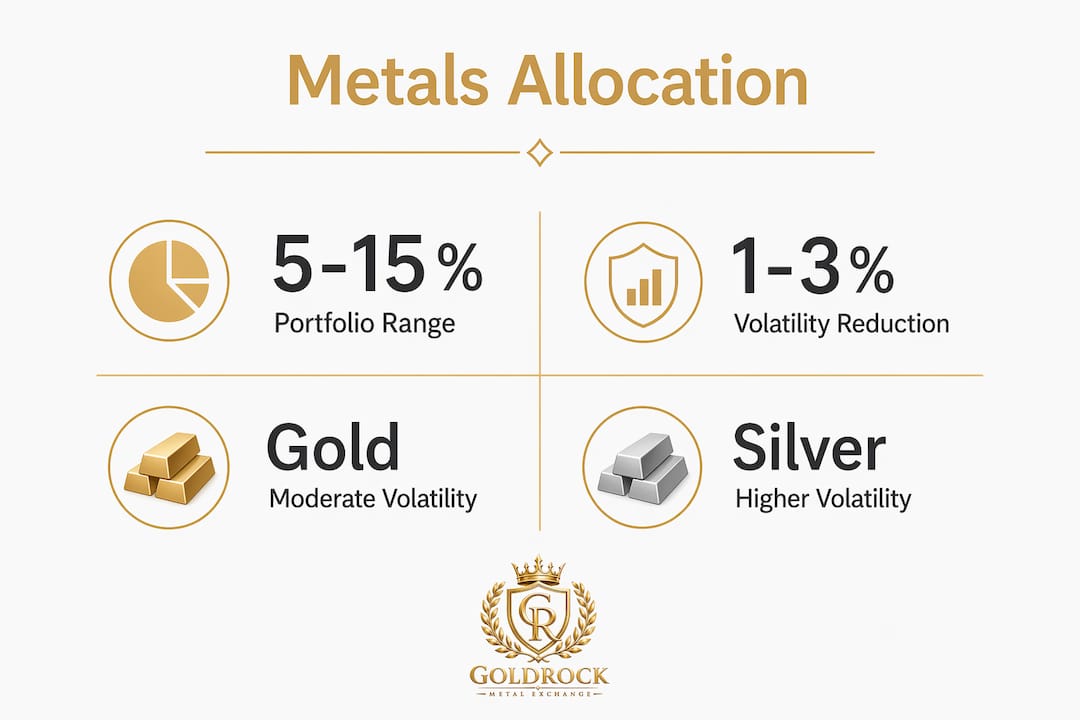
Gold is the primary metal for reducing portfolio risk due to its lowest correlation and highest liquidity among precious metals. Silver is more volatile and more correlated with industrial equities, which limits its diversification value. Platinum and palladium carry even higher volatility and should represent only small tactical positions.
A few guardrails help keep the allocation disciplined:
- Cap total metals exposure at 15% of portfolio value to avoid concentration risk.
- Limit metals to 2%–3% of total portfolio risk contribution, not just dollar weight.
- Treat gold as the anchor. Add silver or others only after gold is established.
- Avoid increasing metals exposure during a market panic. That is when prices spike and the diversification math breaks down.
Pro Tip: Calculate your metals’ risk contribution using standard deviation and correlation data, not just the dollar percentage. Your financial advisor or a risk analytics tool can run this in minutes.
Which investment vehicle fits your tax situation?
Gold is the primary metal for diversification. The vehicle you use to hold it matters as much as the allocation size. Physical bullion, exchange-traded funds (ETFs), and mining equities each carry different cost structures, liquidity profiles, and tax treatments.
Physical precious metals held in taxable accounts are taxed as collectibles, often at rates higher than long-term capital gains rates on stocks. That tax drag can meaningfully reduce after-tax returns over a decade. Holding physical metals inside a self-directed IRA eliminates that problem entirely.
| Vehicle | Liquidity | Storage cost | Tax treatment | Risk profile |
|---|---|---|---|---|
| Physical bullion | Low to moderate | Yes, required | Collectible rate in taxable accounts | Direct metal exposure |
| Precious metals ETF | High | None | Standard capital gains | Tracks metal price |
| Mining equities | High | None | Standard capital gains | Equity plus metal risk |
| Self-directed IRA | Moderate | Custodian fees | Tax-deferred or tax-free | Direct metal exposure |
Mining equities carry equity risk on top of metal price risk. They can fall sharply even when gold rises, because company-specific factors like management decisions or production costs drive their prices. They are not a substitute for physical metals or ETFs when the goal is risk reduction.
Tax-advantaged accounts like IRAs are the most efficient vehicle for holding physical metals long-term. Goldrockmetalexchange operates a dedicated in-house IRA department that handles the account transfer process directly, which removes the administrative friction that stops most investors from acting.
Pro Tip: If you hold metals in a taxable account, track your cost basis carefully. The collectible tax rate applies to gains, and poor record-keeping leads to overpayment at sale.
How should you rebalance to maintain the risk reduction benefit?
Rebalancing is what keeps the risk reduction working over time. Without it, a strong gold rally pushes your metals allocation above target, increasing concentration risk. A stock rally shrinks it below target, eliminating the diversification benefit.
Annual or threshold-based rebalancing maintains diversification benefits while keeping transaction costs low. The threshold approach works well in practice: rebalance when your metals allocation drifts more than 5 percentage points from its target. That triggers action only when it matters, not on a rigid calendar.
Rebalancing metals also generates a measurable return benefit. Selling metals when they are high and buying equities, then reversing when equities fall, enforces a buy-low, sell-high discipline automatically. This volatility harvesting effect can add 0.5%–1% in annualized returns over time. That is not a trivial number compounded over 20 years.
A practical rebalancing plan has four steps:
- Set your target allocation and acceptable drift band before you invest. Write it down.
- Review your portfolio quarterly. Check whether metals have drifted beyond the 5% threshold.
- Rebalance using new contributions first. Selling assets triggers taxes; adding to underweight positions does not.
- Document every rebalancing decision. This prevents emotional override during market stress.
The biggest rebalancing mistake is selling metals during a calm market because they “haven’t done anything lately.” Metals earn their place during the next crisis, not the last one. Discipline through a written plan is the only reliable defense against that mistake.
Metals are also unsuitable for money you need within one year. Short investment timelines expose you to metals’ price volatility without giving the diversification benefit time to work. Treat metals as a long-term position, not a liquid reserve.
Key Takeaways
Allocating 5%–15% of your portfolio to gold and other precious metals, sized by risk contribution rather than dollar percentage, is the most reliable method to reduce portfolio volatility without sacrificing long-term returns.
| Point | Details |
|---|---|
| Allocation range | A 5%–15% metals allocation reduces portfolio volatility by 1–3 percentage points. |
| Risk contribution sizing | Size metals by risk contribution, not dollar weight, to avoid hidden concentration risk. |
| Gold as the anchor | Gold offers the lowest correlation and highest liquidity among precious metals. |
| Tax-efficient vehicles | Hold physical metals in a self-directed IRA to avoid the collectible tax rate. |
| Rebalancing discipline | Threshold-based rebalancing adds 0.5%–1% in annualized returns through volatility harvesting. |
What I have learned about metals and real portfolio risk
The conventional pitch for precious metals focuses almost entirely on inflation protection. That framing misleads investors into treating metals as a short-term trade rather than a structural portfolio position.
My view, after watching investors make this mistake repeatedly, is that metals earn their place through correlation, not inflation. The inflation hedge narrative is real but inconsistent. Gold does not always rise with CPI. What it does consistently is move differently from stocks, and that difference is what reduces your portfolio’s worst-case outcomes.
The investors I have seen benefit most from metals are the ones who built a personalized allocation plan before a crisis hit and stuck to it afterward. They did not double their gold position in march 2020 when fear peaked. They held their pre-set allocation, rebalanced into equities when stocks were cheap, and came out ahead.
The investors who struggled treated metals as a panic button. They bought heavily at the top of a fear spike, then sold when calm returned. That behavior destroys the very benefit metals are supposed to provide.
One more thing worth saying directly: the vehicle matters as much as the metal. Holding physical gold in a taxable account and ignoring the collectible tax rate is a common and expensive mistake. A self-directed precious metals IRA solves that problem cleanly for most retirement investors.
— Blake
Goldrockmetalexchange can help you put this into practice
Knowing the right allocation range is one thing. Executing it correctly, with the right metal, the right vehicle, and a rebalancing plan that holds up under pressure, is where most investors need support.

Goldrockmetalexchange offers physical gold, silver, platinum, and palladium through its full product catalog, along with a dedicated IRA department that handles account transfers directly. The team provides personalized guidance on allocation sizing, vehicle selection, and storage, backed by insured delivery on every physical order. Goldrockmetalexchange also publishes live metal prices so you can time purchases and track your allocation in real time. If you are ready to build a metals position that actually reduces your portfolio risk, Goldrockmetalexchange is the place to start.
FAQ
How much of my portfolio should be in precious metals?
The standard allocation range is 5%–15% of total portfolio value. Size within that range based on your risk tolerance and how much of your portfolio is already in equities.
Why do precious metals hedge inflation in a retirement portfolio?
Gold and other metals tend to hold purchasing power over long periods because their supply is constrained. However, their more reliable benefit is low correlation with stocks, which reduces portfolio drawdowns regardless of inflation conditions.
What is the best way to hold physical gold in a retirement account?
A self-directed IRA is the most tax-efficient vehicle for physical gold. It avoids the collectible tax rate that applies in taxable accounts and allows tax-deferred or tax-free growth depending on the account type.
How often should I rebalance my precious metals allocation?
Rebalance annually or when your metals allocation drifts more than 5 percentage points from its target. This approach maintains diversification benefits while keeping transaction costs and tax events to a minimum.
Are silver and platinum as effective as gold for reducing portfolio risk?
Gold is the most effective metal for risk reduction due to its lowest correlation with equities and highest liquidity. Silver and platinum are more volatile and more correlated with industrial activity, making them supplementary positions rather than core holdings.