
Starting a precious metals portfolio means buying physical metals or related financial products to diversify wealth and protect against inflation and market volatility. Gold hit more than $4,620 per ounce in 2026, a rise of over 71% year over year, which signals just how much investor demand has shifted toward hard assets. Both FINRA and Fidelity frame precious metals as long-term diversification tools, not short-term trades. This guide gives you a clear, practical path from zero to a working metals position.
What should you include when starting a precious metals portfolio?
Gold, silver, and platinum are the three metals most investors start with. Each plays a different role, and understanding those differences helps you build a balanced position from day one.
Gold is the anchor metal. It carries the lowest volatility of the three, holds deep liquidity in global markets, and has the strongest track record as an inflation hedge. The tradeoff is price: at current levels, a single ounce requires a significant cash commitment.
Silver is the entry point for smaller budgets. Starting with silver makes sense for investors with under $500, while gold becomes more cost-effective above $2,000 due to lower per-ounce premiums. Silver also carries more industrial demand, which adds a growth dimension that gold lacks. The downside is higher price volatility.
Platinum sits between the two. It trades at a discount to gold in many market cycles, which creates a potential value opportunity, but its market is thinner and less liquid. Most beginners treat platinum as a secondary position after establishing gold and silver.
How much should you allocate?
Recommended allocation to precious metals runs from 5% to 15% of total portfolio value. Allocations below 5% produce negligible diversification benefit. Allocations above 15% concentrate too much capital in non-yielding assets. Start at the lower end of that range and adjust as you gain confidence.
| Metal | Price volatility | Liquidity | Inflation hedge | Best for |
|---|---|---|---|---|
| Gold | Low | Very high | Strong | Core holding, large budgets |
| Silver | High | High | Moderate | Entry-level, smaller budgets |
| Platinum | Medium | Moderate | Moderate | Secondary diversification |
Pro Tip: Start with a 5% allocation and review it every six months. Adjust upward only after you understand how metals move relative to the rest of your portfolio.
How do you start investing: physical metals, ETFs, or IRAs?
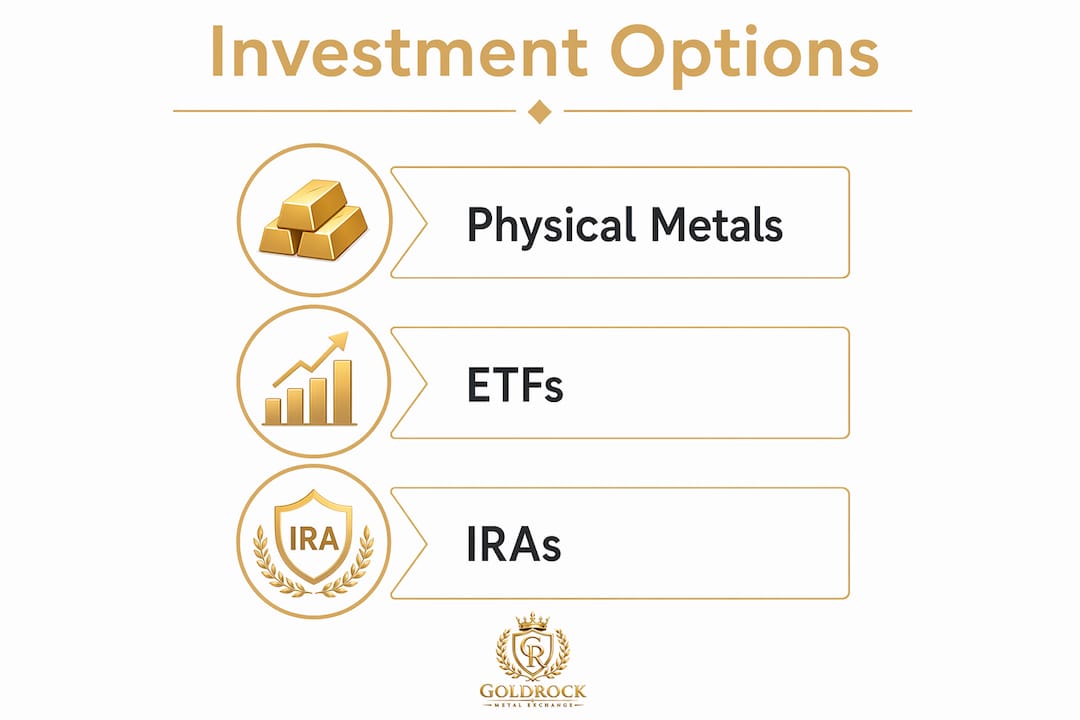
Three main vehicles give you exposure to precious metals. Each fits a different combination of budget, preference, and tax situation.
Physical bullion
Physical bullion means you own the metal directly, whether coins, bars, or rounds. The advantages are real: no counterparty risk, no fund fees, and full ownership of a tangible asset. Physical metals serve as crisis-proof assets that hold value when financial systems come under stress. The drawbacks are storage, insurance, and the premium you pay above the spot price when buying.
- Pros: Direct ownership, no fund expenses, tangible asset, no counterparty risk
- Cons: Requires secure storage, insurance costs, premiums above spot price, less liquid than ETFs
Precious metals ETFs
ETFs track the price of a metal without requiring you to store anything. They trade on stock exchanges like any share, which makes buying and selling fast and cheap. The tradeoff is that you hold a paper claim, not the metal itself. ETFs work well for investors who want price exposure without the logistics of physical ownership.
- Pros: Easy to buy and sell, no storage needed, low transaction costs
- Cons: No physical ownership, fund management fees, counterparty exposure
Precious metals IRAs
A self-directed precious metals IRA lets you hold physical gold, silver, platinum, or palladium inside a tax-advantaged retirement account. Contributions may be pre-tax (traditional IRA) or post-tax (Roth IRA), and gains grow without annual tax drag. Goldrockmetalexchange operates a dedicated in-house IRA department that handles the account transfer process directly, which removes most of the administrative friction for new investors.
- Pros: Tax-advantaged growth, physical metal ownership, retirement account protection
- Cons: Contribution limits apply, IRS-approved metals only, custodian fees required
What fees and costs should you expect?
Fees are the most overlooked factor in precious metals investing. They directly reduce your net return, and some dealers use them to obscure the true cost of a transaction.
Premiums are the markup above the spot price that dealers charge on physical metal. A standard American Eagle gold coin typically carries a premium of several percentage points above spot. Premiums on silver coins run higher as a percentage because the base price is lower. Always compare the all-in price, not just the spot price.
Commissions and storage fees add another layer. FINRA warns investors to get all fees, commissions, and storage costs in writing before completing any transaction. Some dealers charge for nonexistent insurance or storage services. A written fee disclosure protects you from those inflated charges.
Storage options break down into two categories: home storage and third-party vaults. Insurance and storage costs can erode small portfolios, so the right choice depends on the size of your holdings. Small positions often work fine in a quality home safe. Larger portfolios benefit from third-party vault storage, which offers professional security and documented chain of custody.
- Request a full written fee schedule from any dealer before buying.
- Compare premiums across at least two reputable dealers before committing.
- Calculate your total annual storage and insurance cost as a percentage of your holdings.
- Verify dealer credentials through FINRA’s BrokerCheck or your state securities regulator.
- Review your delivery and storage options before your first purchase.
Pro Tip: Goldrockmetalexchange offers insured private delivery on physical metals. That removes the storage setup burden for new investors and gives you documented proof of insured transit.
What are the best practices for building your metals holdings over time?
Building a metals position is a long-term process. Precious metals reduce correlation with stocks and bonds over time, but only if you hold them consistently through market cycles.
Dollar-cost averaging is the most practical strategy for most investors. Dollar-cost averaging reduces timing risk and builds systematic investing habits. Instead of trying to buy at the perfect price, you commit a fixed dollar amount on a regular schedule, monthly or quarterly. That approach smooths out price volatility and removes the emotional pressure of market timing.
Prioritize liquid, recognized products. Sovereign-minted coins like American Eagles provide superior liquidity and recognition compared to generic rounds or bars. When you eventually sell, widely recognized coins find buyers faster and often at better prices. Generic bars may carry lower premiums on purchase but can be harder to sell at full value.
Review your allocation regularly. Geopolitical uncertainty and central bank activity drive metals prices in ways that can shift your portfolio balance over time. A quarterly review lets you rebalance back to your target allocation without overreacting to short-term price moves.
- Set a fixed purchase schedule and stick to it regardless of price direction.
- Keep at least half your physical metals in sovereign-minted coins for resale ease.
- Review total allocation every quarter and rebalance if metals drift above 15%.
- Track your average cost per ounce to measure real performance over time.
Pro Tip: Treat your metals position like a savings account, not a trading account. Consistent, patient accumulation outperforms reactive buying and selling in almost every market cycle.
Key Takeaways
A well-structured precious metals portfolio allocates 5% to 15% of total portfolio value across gold, silver, and platinum, uses dollar-cost averaging for consistent accumulation, and prioritizes sovereign-minted coins for liquidity and long-term resale value.
| Point | Details |
|---|---|
| Allocation range | Keep metals between 5% and 15% of total portfolio for meaningful diversification. |
| Start with silver | Investors with budgets under $500 get more metal per dollar with silver than gold. |
| Get fees in writing | Always request a full written fee schedule before purchasing from any dealer. |
| Use sovereign coins | American Eagles and similar coins offer better liquidity and resale recognition. |
| Dollar-cost average | Fixed regular purchases reduce timing risk and build disciplined investing habits. |
What I’ve learned from watching investors enter this market
The biggest mistake I see new investors make is treating precious metals like a stock pick. They buy a large position after a price spike, then panic when prices pull back. That pattern destroys the entire purpose of holding metals.
The investors who build real wealth with metals do the opposite. They start small, usually with silver, and add consistently over months and years. They focus on recognized products like American Eagles rather than chasing the lowest premium on obscure bars. And they treat the position as a permanent part of their portfolio, not something to exit when the market gets interesting.
The other thing I’d emphasize is dealer selection. The fee structures in this market vary enormously. I’ve seen investors pay premiums two or three times higher than necessary simply because they didn’t compare dealers or ask for written disclosures. Goldrockmetalexchange’s approach of putting everything in writing and offering insured delivery is exactly the kind of transparency that protects new investors. The education resources at Goldrockmetalexchange are also worth your time before you make your first purchase.
Patience is the actual edge in this market. The investors who treat metals as a long-term risk management tool, not a short-term trade, consistently come out ahead.
— Blake
Goldrockmetalexchange: physical metals and IRAs for new investors
Goldrockmetalexchange offers a full range of physical gold, silver, platinum, and palladium products, from sovereign-minted coins to bars, all available through its metals shop. Every purchase comes with insured private delivery, so your metals arrive securely without you needing to arrange third-party logistics.

For investors focused on retirement, Goldrockmetalexchange’s dedicated IRA department handles the full transfer process for self-directed precious metals IRAs, including account setup and IRS-compliant storage arrangements. The team provides personalized guidance at every step, which makes the process straightforward even for first-time buyers. If you want to build a position backed by real assets and professional support, Goldrockmetalexchange is the place to start.
FAQ
What is a precious metals portfolio?
A precious metals portfolio is a collection of physical metals or metal-backed financial products held as part of a diversified investment strategy. Gold, silver, platinum, and palladium are the most common assets included.
How much should a beginner invest in precious metals?
Financial professionals recommend allocating 5% to 15% of your total portfolio to precious metals. Allocations below 5% produce negligible diversification benefit.
Is silver or gold better for beginners?
Silver is more practical for budgets under $500 because it delivers more metal per dollar. Gold becomes more cost-effective above $2,000 due to lower per-ounce premiums.
What is a precious metals IRA?
A precious metals IRA is a self-directed retirement account that holds physical gold, silver, platinum, or palladium instead of stocks or bonds. It offers the same tax advantages as a traditional or Roth IRA.
How do I avoid scams when buying physical metals?
Always request a full written fee disclosure before purchasing, and verify dealer credentials through FINRA’s BrokerCheck. FINRA warns that some dealers charge for nonexistent storage or insurance services.