

Palladium is defined as a platinum-group metal (PGM) whose role in retirement portfolios is to provide industrial-driven diversification that gold and silver cannot replicate. Unlike gold, which responds primarily to inflation and currency fears, palladium’s price is tied to automotive manufacturing cycles, emissions regulations, and geopolitical supply risks. Financial advisors recommend allocating 5–15% of a retirement portfolio to precious metals, with palladium serving as a tactical slice within that range. For investors approaching retirement, understanding the role of palladium in retirement planning means knowing both its unique upside and its very real structural risks.
How does palladium’s industrial demand shape its investment role?
Palladium’s price is driven by one dominant force: gasoline engine catalytic converters. Over 80% of palladium demand comes from this single application, which makes it unlike any other precious metal in your portfolio. That concentration creates sharp price swings when auto production rises or falls, and it means palladium responds to factory output data, not just monetary policy.
The supply side adds another layer of risk. Supply is concentrated mainly in Russia and South Africa, two regions with histories of export disruption and labor instability. A single geopolitical event in either country can move palladium prices dramatically within days. That kind of sensitivity is rare among traditional retirement assets.

Electric vehicle adoption is the structural headwind that every palladium investor must understand. Every battery electric vehicle sold removes 2–7 grams of palladium demand, and EVs are projected to reach 50% of new vehicle sales by 2030. That trajectory puts long-term pressure on palladium prices in a way that has no parallel in gold or silver markets.
Emerging applications in hydrogen fuel cells and electronics exist, but they remain small relative to automotive demand. They are not yet large enough to offset the EV transition risk. Palladium’s industrial story is still primarily an automotive story.
- Catalytic converter demand accounts for more than 80% of total palladium consumption
- Russia and South Africa together control the majority of global palladium supply
- Each battery EV sold eliminates 2–7 grams of palladium demand
- Hydrogen and electronics uses are growing but remain a minor share of total demand
- Auto production cycles directly drive short-term price volatility
Pro Tip: Watch quarterly auto production reports from major markets like the U.S., China, and Europe. These numbers move palladium prices faster than almost any other data point.
What are the benefits and risks of palladium in retirement portfolios?
Small allocations of palladium can meaningfully enhance portfolio risk dispersion and smooth returns across economic cycles. The key reason is that palladium’s price drivers are almost entirely separate from those of stocks, bonds, and even gold. When equity markets fall due to recession fears, palladium may hold value if auto demand stays firm. That non-correlation is the core palladium investment benefit for retirement savers.
Experts treat palladium as a tactical metal rather than a core holding. Palladium is suited for active investors who can monitor industrial trends, not for those seeking a passive, set-and-forget safe haven. That distinction matters enormously for someone within five to ten years of retirement. You need to know what you own and why you own it.
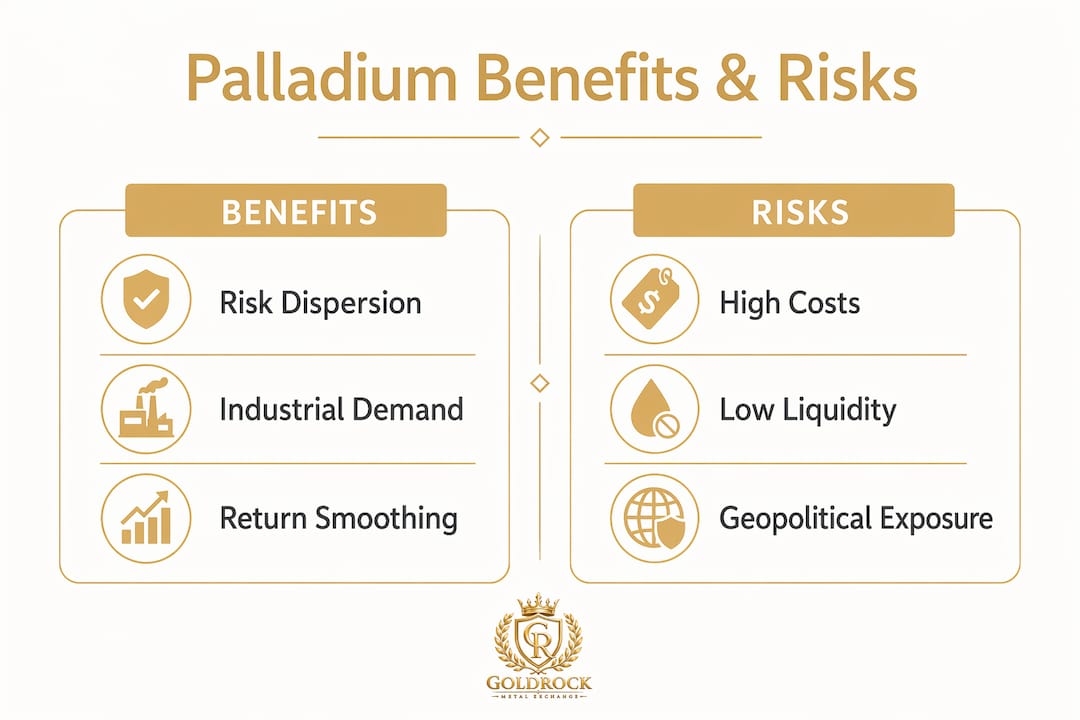
The risks are real and specific. Physical palladium carries higher transaction costs and lower liquidity than gold or silver, with wider bid-ask spreads that eat into returns on both entry and exit. The EV transition creates a structural demand ceiling that does not exist for gold. Geopolitical supply disruptions can spike prices temporarily, but those spikes can reverse just as fast.
| Risk factor | Palladium | Gold |
|---|---|---|
| Primary price driver | Automotive industrial demand | Inflation and currency risk |
| Supply concentration | High (Russia, South Africa) | Moderate (globally distributed) |
| EV transition exposure | Direct and significant | None |
| Liquidity | Lower, wider spreads | High, tight spreads |
| IRA eligibility | Yes, 99.95% purity required | Yes, 99.5% purity required |
Pro Tip: Keep palladium as a subset of your total precious metals allocation. If you hold 10% of your portfolio in metals, palladium should represent a fraction of that, not the whole position.
How does a palladium IRA work?
A palladium self-directed IRA is a tax-advantaged retirement account that holds physical palladium instead of stocks or mutual funds. Palladium IRAs provide tax-deferred growth and must comply with IRS storage and distribution regulations, just like a traditional IRA. The structure is the same; the asset inside is different.
The IRS sets strict standards for what qualifies. Palladium IRA investments must meet a minimum purity of 99.95% and must be stored with an approved custodian in IRS-approved depositories. You cannot take physical possession of the metal while it sits inside the IRA. Doing so triggers a taxable distribution.
Approved products for a palladium IRA include specific bars and coins that meet the purity threshold. The most widely held are palladium bars from recognized refiners and the Canadian Maple Leaf palladium coin, which meets IRS standards. Not every palladium product qualifies, so product selection matters before you buy.
Here is how the process works in practice:
- Open a self-directed IRA with a custodian that handles precious metals accounts
- Fund the account through a rollover from an existing 401(k) or IRA, or through a direct contribution
- Select IRS-eligible palladium products that meet the 99.95% purity standard
- Direct your custodian to purchase the metal on your behalf
- The custodian arranges storage at an IRS-approved depository
- Annual storage fees apply and vary by depository and account size
Storage fees and custodian fees are ongoing costs that reduce net returns. Factor these into your total cost of ownership before committing. You can learn more about IRA storage requirements and how they apply to palladium alongside other metals.
| IRA requirement | Palladium standard |
|---|---|
| Minimum purity | 99.95% |
| Storage | IRS-approved depository only |
| Tax treatment | Tax-deferred (traditional) or tax-free growth (Roth) |
| Eligible products | Approved bars and coins (e.g., Canadian Maple Leaf) |
| Personal possession | Not permitted while in IRA |
What are the best strategies for allocating palladium in retirement?
Palladium works best as a small, deliberate position within a broader precious metals allocation. Including platinum and palladium alongside gold enhances portfolio resilience by diversifying price drivers across different economic conditions. The goal is not to maximize palladium exposure. The goal is to add a price driver that gold and silver do not provide.
Dollar-cost averaging is the most practical entry method for palladium. Because prices swing sharply on auto production news and geopolitical events, buying in fixed dollar amounts over time reduces the risk of a poorly timed lump-sum purchase. This approach is especially relevant for retirement investors who cannot afford to absorb a large short-term loss near their target retirement date.
Active monitoring is not optional with palladium. You need to track EV adoption rates, auto production data, and supply news from Russia and South Africa on a regular basis. This is not a metal you buy and ignore for a decade. If EV adoption accelerates faster than projected, a position reduction may be warranted.
- Limit palladium to a fraction of your total 5–15% precious metals allocation
- Use dollar-cost averaging to manage entry price risk
- Balance palladium with gold and platinum to spread price-driver risk
- Review your position at least quarterly against EV adoption and auto production trends
- Account for storage fees, custodian fees, and bid-ask spreads in your return projections
- Work with a dealer that specializes in palladium IRA products and understands IRS compliance requirements
Pro Tip: If you are within three years of retirement, keep palladium at the lower end of your metals allocation. Liquidity matters more as you approach the distribution phase, and palladium’s wider spreads can cost you on exit.
Key Takeaways
Palladium plays a specialized, tactical role in retirement portfolios by adding industrial-demand diversification that gold and silver cannot provide, but it requires active monitoring and careful position sizing to manage its unique risks.
| Point | Details |
|---|---|
| Tactical allocation only | Keep palladium as a small subset of a 5–15% total precious metals allocation. |
| Industrial demand drives price | Over 80% of demand comes from catalytic converters, making auto trends the key price signal. |
| EV transition is a real risk | Each battery EV sold removes 2–7 grams of demand; monitor adoption rates actively. |
| IRS purity standard is strict | Palladium IRA products must meet 99.95% purity and be stored in approved depositories. |
| Liquidity costs are higher | Wider bid-ask spreads and storage fees reduce net returns compared to gold or silver. |
Palladium is not for passive investors, and that’s the point
I have watched a lot of retirement investors make the same mistake with palladium. They hear “precious metal” and assume it behaves like gold. It does not. Gold is a monetary metal. Palladium is an industrial one. That difference changes everything about how you should hold it, size it, and monitor it.
The investors who benefit most from palladium are those who treat it as a deliberate, informed position. They know the EV adoption numbers. They watch Russian supply news. They understand that a price spike driven by a supply disruption is not the same as a price gain driven by fundamental demand growth. One is durable; the other reverses.
My honest view is that palladium belongs in a retirement portfolio the way a specialist belongs on a medical team. You do not replace your primary care doctor with a specialist. You bring one in for a specific purpose. Palladium’s purpose is to add a price driver that responds to industrial cycles, not just inflation or currency risk. Used that way, it earns its place. Used as a substitute for gold, it creates unnecessary risk for someone approaching retirement.
The palladium market stress guide from Goldrockmetalexchange is worth reading before you make any allocation decision. Understanding how palladium behaves under pressure is as important as understanding why you want it in the first place.
— Blake
Goldrockmetalexchange and your palladium retirement plan
Goldrockmetalexchange specializes in helping retirement investors hold physical precious metals inside self-directed IRAs, including palladium that meets IRS purity and storage standards. The in-house IRA department handles the account transfer process and custodian coordination, so you are not navigating IRS compliance requirements alone.
Goldrockmetalexchange offers palladium IRA accounts alongside gold, silver, and platinum options, giving you the flexibility to build a balanced precious metals allocation in one place. The team provides personalized consultations to help you size your palladium position correctly relative to your overall retirement timeline and risk tolerance. You can also browse physical palladium products that meet IRS eligibility standards directly through the Goldrockmetalexchange product catalog.
FAQ
What is the role of palladium in retirement portfolios?
Palladium provides industrial-demand diversification in retirement portfolios that gold and silver cannot replicate. Its price responds to automotive manufacturing cycles and geopolitical supply risks, making it a non-correlated complement to traditional assets.
How much palladium should I hold in my retirement account?
Financial advisors recommend 5–15% of a retirement portfolio in precious metals total, with palladium representing a small fraction of that allocation. Investors within a few years of retirement should keep palladium at the lower end due to its liquidity constraints.
What purity does palladium need to qualify for an IRA?
The IRS requires palladium held in a self-directed IRA to meet a minimum purity of 99.95%. The metal must also be stored in an IRS-approved depository through a qualified custodian.
Does the electric vehicle transition affect palladium investments?
Yes. Each battery electric vehicle sold removes 2–7 grams of palladium demand, and EVs are projected to reach 50% of new vehicle sales by 2030. This structural trend creates long-term price pressure that retirement investors must monitor actively.
Is physical palladium harder to sell than gold?
Physical palladium carries lower liquidity and wider bid-ask spreads than gold or silver. Those higher transaction costs affect both your entry price and your exit proceeds, so they must be factored into your total return calculation before investing.